REVIEW · MADRID
Royal Palace & Old City Madrid Guided Tour Semi-Private 8ppl Max
Book on Viator →Operated by Babylon Tours Madrid · Bookable on Viator
Royal Palace lines are the worst kind of wait. This semi-private Madrid tour swaps that headache for skip-the-line Royal Palace entry and a small-group Old City walk with a real guide to connect the dots. I like the max 8 size because it keeps the pace human and questions actually get answered.
The one thing to keep in mind is that it is still a walking day with a couple museum-and-square stops, so moderate walking helps. Also, appropriate dress may be needed for entry at some sites, and security lines can still happen even with skip-the-line access.
In This Review
- Key Things You’ll Notice on This Tour
- How a Max-8 Group Changes Your Old City Experience
- Meeting at Plaza de la Armería and Walking to Puerta del Sol
- Almudena Cathedral and the Museum Inside the Church Walls
- Plaza de la Villa: Medieval Madrid’s Best-Preserved Corner
- The Arab Wall on Cuesta de la Vega
- Calle Mayor: The Street That Became the Main Stage
- Arco de Cuchilleros and La Latina’s Narrow-Street Madrid
- Puerta del Sol: The Center, the Clock, and the Twelve Grapes
- Mercado San Miguel: A Food-Lover Stop Near Plaza Mayor
- Plaza Mayor and Real Casa de Postas: Old Power Meets Administration
- Entering the Royal Palace: Sabatini Stairs, Tiepolo Ceiling, and Stradivari
- What the Price Really Buys at $229.01 Per Person
- Who This Tour Fits Best (and Who Might Want to DIY)
- Should You Book This Royal Palace and Old City Semi-Private Tour?
- FAQ
- How long is the Royal Palace & Old City Madrid guided tour?
- What group size is this tour?
- Where does the tour start and end?
- Is the Royal Palace admission included?
- Is the tour offered in English?
- Is there a lunch break during the tour?
- Can I cancel and get a full refund?
Key Things You’ll Notice on This Tour
- Small group (up to 8) keeps history talk clear and personal, not lecture-mode
- Royal Palace admission included with a guided focus on the palace’s biggest art and design hits
- Old Madrid layers in sequence from Almudena down through medieval squares and Arabic-era walls
- Calle Mayor and La Latina give you street-level context, not just postcard views
- Puerta del Sol + Mercado San Miguel adds a practical city-food moment near the center
- Sabatini, Tiepolo, and Stradivari details inside the palace make the visit feel specific, not generic
How a Max-8 Group Changes Your Old City Experience
Madrid’s center is easy to wander, but hard to understand without someone steering the story. That is where the semi-private format pays off. When you keep the group to a maximum of eight people, the guide can slow down when something matters, and you can ask follow-ups without waiting for the next person’s question.
In a tour like this, I like how you get both the big landmarks and the connecting tissue between them. You’re not just moving from attraction to attraction—you’re learning how areas link together: medieval streets, Islamic-era remnants, then royal and administrative Madrid coming later.
One bonus detail: the tour can operate with very small numbers if the schedule is quiet. That makes it feel less like a group bus ride and more like you’ve got a walking history lesson with a friend who knows the city.
You can also read our reviews of more tours and experiences in Madrid.
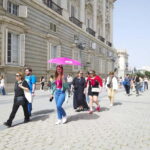

Meeting at Plaza de la Armería and Walking to Puerta del Sol
The day starts at 11:00 am at Plaza de la Armería, then ends at Puerta del Sol. That end point is smart. Sol is the hub for a lot of transit and the starting line for a lot of nighttime wandering later.
You should plan for a mix of short stops and walking segments—no marathon distances are promised, but you will be on your feet through old streets and squares. A moderate physical fitness level is mentioned for a reason: the pace is mostly steady, and you do need to keep moving to hit all the key places.
The tour is also described as being near public transportation, which matters if you’re trying to keep the rest of your day flexible. You’re not getting stuck on the edge of town with a long return trip.
Almudena Cathedral and the Museum Inside the Church Walls
You begin with Museo de la Catedral de la Almudena at Almudena Cathedral. Even if you only get a short visit window, this stop sets the tone: Madrid isn’t only medieval and royal. It also has modern Catholic landmarks that were consecrated in the late 20th century.
The guide points out that the Catholic church was consecrated by Pope John Paul II in 1993. That date anchors the story. It helps you see the city as continuous—different eras added, not wiped out.
You’ll also see the museum that is part of the church. The practical value here is simple: you’re getting context before the tour pushes you into older stone and older street patterns. It prevents the day from feeling like random stops.
Plaza de la Villa: Medieval Madrid’s Best-Preserved Corner
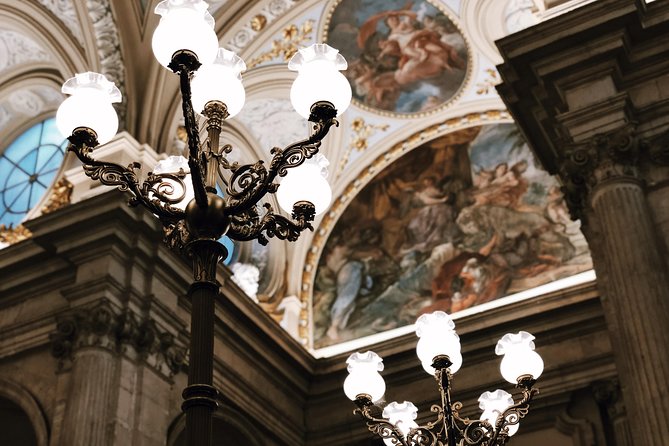
Next up is Plaza de la Villa, reached along Calle Mayor. This is one of Madrid’s best-preserved monuments, sitting in the historical zone near Puerta del Sol.
What I like about this stop is how it turns a square into a time machine. You’re not just looking at buildings—you’re learning why the area matters as one of Madrid’s main medieval centers.
It’s a quick stop by design, so it works best if you treat it like orientation. Look up at the shapes around you, then keep walking. Later, when you see Puerta del Sol and Plaza Mayor, you’ll start noticing how the city’s layout kept evolving around central meeting points.
The Arab Wall on Cuesta de la Vega
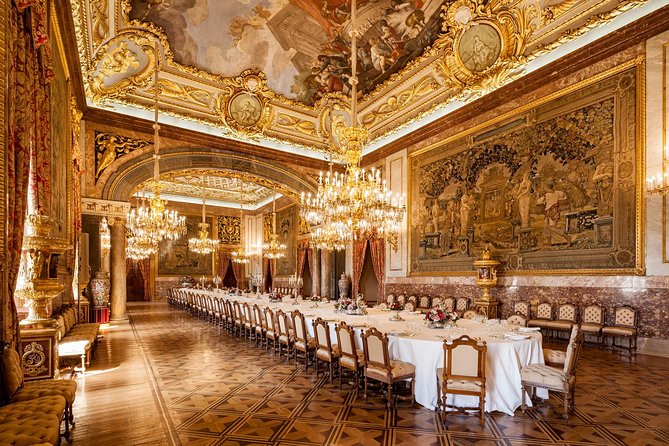
Then you hit the Arab Wall, also called the Muslim Walls of Madrid. These sit on Cuesta de la Vega, and they’re described as some of the oldest surviving construction in the city.
This is a rare moment in many Madrid days: instead of being led mostly by 19th or 16th century power, you’re looking at structures tied to the origins of Madrid. That makes the rest of the old-town walk click. The guide’s framing helps you connect later neighborhoods to earlier beginnings.
The drawback? Because this is an older, outdoor feature, you’ll want to pay attention even when it’s not flashy. The payoff is in the explanation—so don’t tune out just because the wall isn’t a giant palace.



Calle Mayor: The Street That Became the Main Stage
After the walls, you walk along Calle Mayor, a central street that runs from Puerta del Sol toward Cuesta de la Vega. It’s said to have Middle Ages origins and later became the main thoroughfare in the early modern period.
Here is why this stop matters: it is a real street, still used like a street, not a museum corridor. When the guide points out how it grew into the main road, you begin to see why the city still funnels visitors through these corridors today.
Watch how shops, crossings, and views line up. Even with short time, the street gives you a mental map. It is the kind of walking detail that later makes it easier to navigate your own Madrid.
Arco de Cuchilleros and La Latina’s Narrow-Street Madrid
You then see the Arco de Cuchilleros, an old archway with stairs that connect you toward the 16th-century Plaza Mayor area. It’s the kind of historical connector you can easily miss if you’re just snapping photos. With a guide, it becomes a signpost—literally—toward where old Madrid energy flows.
From there, you enter La Latina, a historic neighborhood occupying much of the oldest section of central Madrid. The streets are described as small and narrow, which is exactly the point. This is Madrid at walking speed: tight corners, quick perspective changes, and plenty of places to stop and look again.
A strong thing about this section is the variety of micro-locations:
- Plaza de la Paja, once a major marketplace in the 13th and 14th centuries
- Plaza de los Carros, a smaller square with a fountain where you can grab a drink and watch the movement
- Plaza de Puerta Cerrada, tied to a medieval Islamic fort beneath the neighborhood’s story
These stops work best if you let them breathe for a minute. The names alone hint at function and era. With the guide talking over them, you’ll notice how the same area can feel both lived-in and layered with old structures.
Puerta del Sol: The Center, the Clock, and the Twelve Grapes
You finish this walk segment at Puerta del Sol, one of Madrid’s best-known squares. It sits at the center of the radial road network, meaning many of Madrid’s streets really radiate from here.
The standout detail is the famous clock. Its bells mark the tradition of eating the Twelve Grapes at New Year. Even if you’re not visiting on New Year’s Eve, knowing that ritual makes the clock more than just a photo spot. It becomes a cultural marker.
This stop also functions as a handoff point. You’re moving from old-town discovery toward the palace visit, with the city’s core landmarks now lined up in your mind.
Mercado San Miguel: A Food-Lover Stop Near Plaza Mayor
After Puerta del Sol, the tour heads to Mercado San Miguel, right in the city center next to Plaza Mayor. This is described as a historic market and known for being packed with food from across Spain.
Even if you do not plan to eat a full meal here, this stop is useful. Markets help you understand a place faster than monuments alone. You get a sense of everyday Spanish food culture, plus you’re close to where many classic photos will happen later.
Practical tip: if you’re hungry, this is one of the better moments to snack. If you’re not hungry, it is still a good reset before the big indoor palace time.
Plaza Mayor and Real Casa de Postas: Old Power Meets Administration
You then reach Plaza Mayor, a grand arcaded square that has been popular with both locals and visitors. It was first built during the Habsburg period during the reign of Philipp III and once served as the center of old Madrid.
The guide’s explanations here matter because Plaza Mayor can look like just a beautiful set piece. You get the context of why it mattered as a civic center in earlier centuries, which changes how you perceive the architecture and spacing.
Next is Real Casa de Postas, described as a neoclassical administrative building. The tour focuses on its earlier role as home to telegraph service offices for the National Police force, up until the building was bought by Madrid’s Regional Government in 1985.
This stop is a nice contrast after the marketplace vibe. You get royal-era space, then you shift to the city’s communication-and-control side of history. It helps you see Madrid as a machine that ran on information, not only on pageantry.
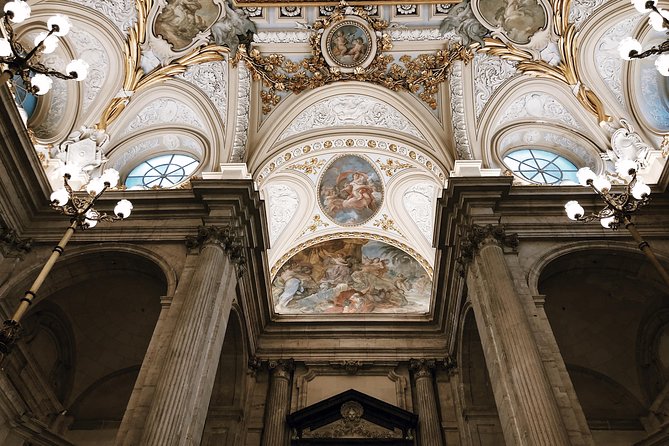
Entering the Royal Palace: Sabatini Stairs, Tiepolo Ceiling, and Stradivari
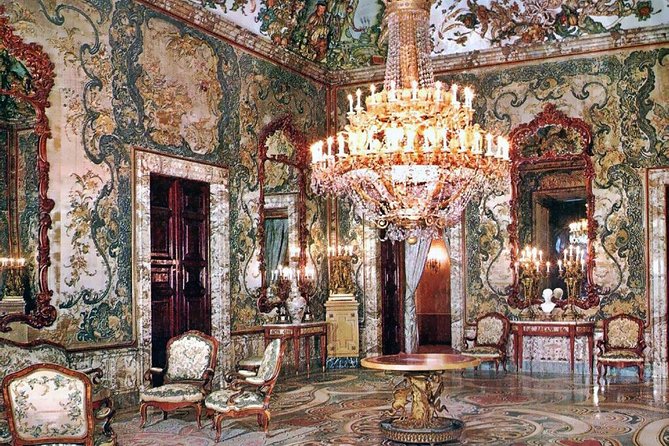
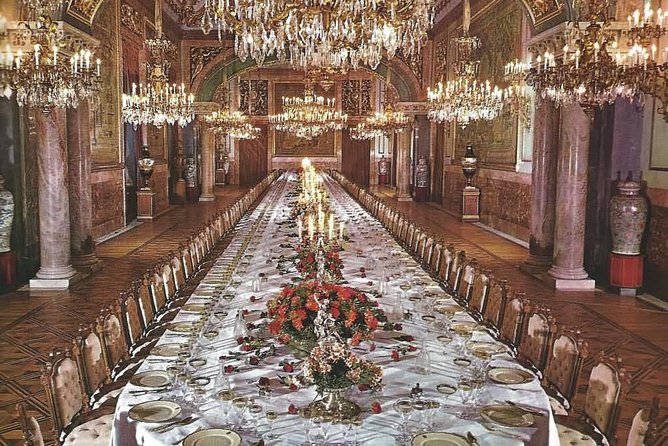
After a break for lunch, you return to the centerpiece: the Royal Palace of Madrid. The palace is open to the public because the royal family uses it mainly for official receptions, and you’re told it has over 3,000 rooms.
You get 2 hours 30 minutes inside, with the Royal Palace admission included. This is the value driver of the whole day. Without a guide, a palace visit can become a blur of rooms. With a guide, it becomes a set of specific design stories and art highlights you can actually remember.
Inside, the tour zeroes in on:
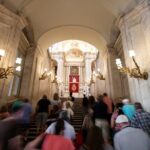
- The main staircase designed by Sabatini, including over 70 steps
- The Throne Room
- The ceiling painted by Tiepolo
- The Hall of Alabarderos, dedicated to the palace guards
- Artworks and artists you can recognize, including Goya, Mengs, and Giaquinto
- The monarchy symbols like the crown and scepter
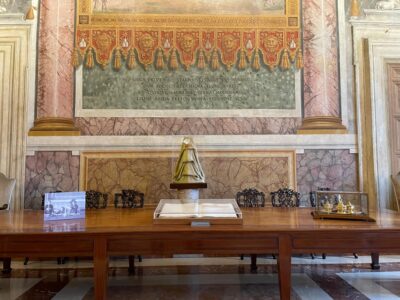
- A complete set of stringed instruments made by Antonio Stradivari
What I like here is that these are not random famous objects. They’re the things that give you a feel for how power is performed—through space, through ceremony, through art, and through the symbolism of what the palace displays.
One more reality check: even with skip-the-line access, some lines can still form due to security measures. The tour notes that possibility. So you still want to arrive with a calm mindset, not a rage-in-your-heart one.
What the Price Really Buys at $229.01 Per Person
At $229.01 per person for about 5 hours 30 minutes, this isn’t the cheapest way to see central Madrid. But it does include the Royal Palace ticket and a professional guide for both the old-city walk and the palace time.
In practical terms, the price mostly covers three things:
- The guided storytelling that makes the city make sense quickly
- The small group size that keeps the experience flexible and interactive
- Royal Palace admission and time inside, where having a guide prevents the visit from turning into aimless wandering
If you’re the kind of person who likes to plan less and understand more, that combination usually feels fair. If you prefer total DIY and are comfortable building your own route plus booking palace time, the cost may feel steep. But for most people who want a clean, guided day, it reads as good value for what’s included.
Who This Tour Fits Best (and Who Might Want to DIY)
This tour fits especially well if you want:
- A guided Old City overview in the morning that sets you up for the rest of your Madrid day
- A small group where questions are welcome
- A focused Royal Palace visit with art and design points you can actually follow
It may not be ideal if you hate walking or you want lots of free time to wander without guidance. Also, because entry at some sites requires appropriate dress, you should bring clothing that works for indoor sites even when the weather is warm.
If you’re doing Madrid for the first time, this is a strong way to get your bearings fast. If you’ve been before, you may still appreciate the route through the older layers and the palace details that many self-guided visits skip.
Should You Book This Royal Palace and Old City Semi-Private Tour?
I’d book it if you want a smart mix of street-level Madrid and a guided Royal Palace visit that actually highlights what matters. The max-8 setup, the palace admission included, and the guide-led explanation of landmarks—from the Arab Wall to Plaza Mayor and into the palace rooms—adds up to a day that feels organized without feeling rushed.
I would hesitate if your schedule is tight, you want zero walking, or you prefer to wander solo with no guided structure. Also remember: security checks can still mean some waiting, even with skip-the-line access.
If you’re trying to choose one guided option for Madrid’s center, this is one of the more practical ways to get history, layout, and royal art in a single half-day loop.
FAQ
How long is the Royal Palace & Old City Madrid guided tour?
It runs for about 5 hours 30 minutes.
What group size is this tour?
It is a semi-private tour with a maximum of 8 people.
Where does the tour start and end?
It starts at Plaza de la Armería (Pl. de la Armería, Centro, 28013 Madrid) and ends at Puerta del Sol.
Is the Royal Palace admission included?
Yes. Royal Palace of Madrid admission is included.
Is the tour offered in English?
Yes, the tour is offered in English.
Is there a lunch break during the tour?
Yes, there is a break for lunch before returning to the Royal Palace visit.
Can I cancel and get a full refund?
Yes. You can cancel up to 24 hours in advance for a full refund.