REVIEW · VENICE
Full Venice Walking Tour: Doge’s Palace and St. Mark’s
Book on GetYourGuide →Operated by Gray Line Venice - Park Viaggi · Bookable on GetYourGuide
Venice rewards you when you dodge the lines. On this walking route, I like how you connect Doge’s Palace political power with St. Mark’s Basilica’s gold mosaics, and you still get the quieter Venice in between with calli and everyday squares where people actually meet. One thing to plan for: even with skip-the-line access, security checks can still slow entry at Doge’s Palace.
You start at Piazza San Marco and walk through major landmarks and story-rich neighborhoods for about 4 to 4.5 hours, guided in English or Spanish. The value is in the pacing: you see the symbols first, then you move into the ticketed wow-stops with less queue stress.
In This Review
- Key Highlights You’ll Notice Right Away
- Venice in One Walk: Piazza San Marco Sets the Tone
- The Side Streets First: Calli, Campos, and Social Squares
- Campo Santa Maria Formosa: SS. Giovanni e Paolo and the Pantheon
- Scuola Grande di San Marco: The Great School of Charity
- Le Mercerie and Teatro Malibran: Venice’s Old Commercial Heart
- Skipping Lines at Doge’s Palace: What to Expect Inside
- St. Mark’s Basilica: Saint Mark, Gold Mosaics, and the Pala d’Oro
- Price and Timing: Is $142.74 Worth It?
- Meeting Point Reality Check: Maps, Radios, and Group Flow
- Who Should Book This Tour
- Should You Book This Venice Walking Tour?
- FAQ
- FAQ
- How long is the Full Venice Walking Tour: Doge’s Palace and St. Mark’s?
- Where does the tour start?
- What’s included in the price?
- Do I need to buy tickets for Doge’s Palace or St. Mark’s Basilica?
- What should I bring?
- Are there dress rules for St. Mark’s Basilica?
- Is this tour wheelchair accessible?
Key Highlights You’ll Notice Right Away
- Piazza San Marco orientation first: St. Mark’s Clock Tower and the Procuratie are shown from outside so you know where you are before the big entrances.
- Everyday Venice in the middle: calli, small squares, and meeting spots that feel less like a museum hallway.
- SS. Giovanni e Paolo and its Pantheon: a satisfying stop that adds depth beyond just the St. Mark’s area icons.
- Scuola Grande di San Marco (Great School of Charity): history tied to Venice’s explorers and the Captains of Fortune idea.
- Two major skips, not one: Doge’s Palace entry plus St. Mark’s Basilica entry are both handled with skip-the-line access.
- Guides can make or break the flow: some guides are praised for clarity and practical pacing, so you may want to be near the guide early.
Venice in One Walk: Piazza San Marco Sets the Tone
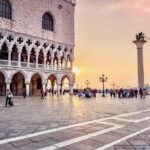
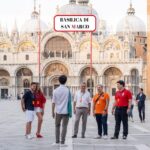
Piazza San Marco is the place where Venice performs. It’s where you feel the city’s power—built on water, money, and influence—before you even step into the monuments. Starting here makes sense because most of what you’ll see later is part of the same story loop: the sea brings wealth, and the wealth gets turned into art, architecture, and ceremonies.
This tour uses the plaza as a living map. You’ll get external views of major features like the St. Mark’s Clock Tower and the Procuratie, which helps you read the space instead of just passing through it. I also like that it doesn’t jump straight into tickets; you get bearings fast, and that makes the later interiors hit harder.
Practical tip: bring comfortable shoes and plan for stone floors and lots of walking. You’ll be on your feet for most of the 4 to 4.5 hour experience.
You can also read our reviews of more tours and experiences in Venice.



The Side Streets First: Calli, Campos, and Social Squares
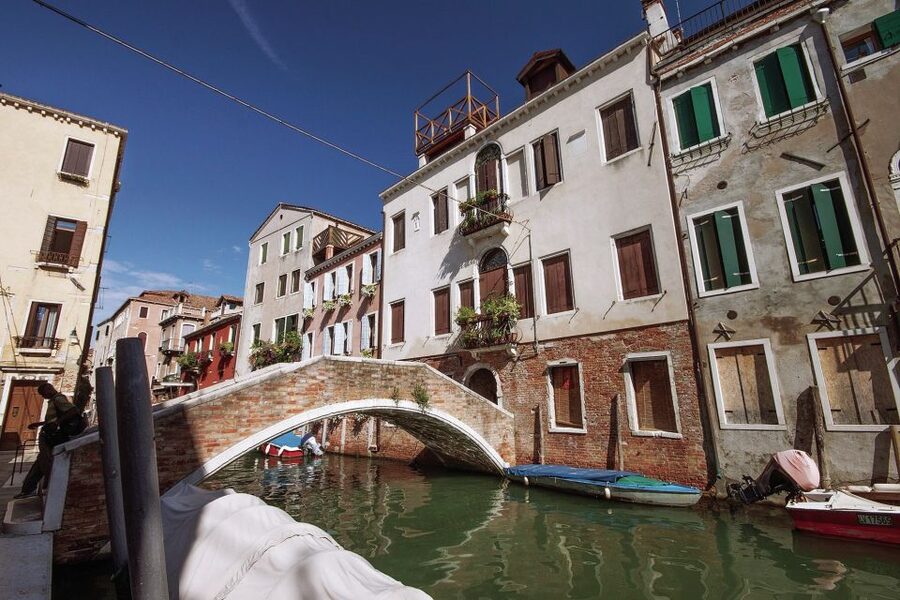
After the plaza orientation, the walking part becomes the fun part. Venice isn’t only landmarks—it’s the daily choreography of people moving through narrow lanes and pausing in small public rooms. You’ll stroll down the small alleys called calli, cross to picturesque squares, and see corners where Venetians still socialize.
That matters more than it sounds. When you later enter Doge’s Palace and St. Mark’s Basilica, your brain already understands the city’s scale and layout. You’re not just collecting sights; you’re seeing how the city actually works on a day-to-day level.
Also, this is a nice way to spread out the intensity. Instead of waiting in one giant line after another, you build momentum by moving through different vibes: plaza grandeur, alley intimacy, then back to the big-ticket monuments.
Campo Santa Maria Formosa: SS. Giovanni e Paolo and the Pantheon
One of the stops that gives you a change of scenery is Campo Santa Maria Formosa. From there, you’ll admire the church of SS. Giovanni e Paolo, including its famous Pantheon. This is a smart contrast to the St. Mark’s area focus.
Why it’s worth your time: it widens the lens. Venice’s major names and sacred spaces aren’t all clustered in one spot, and SS. Giovanni e Paolo brings you into a slightly different architectural and cultural mood. If you’ve only come for the headline sites, this stop keeps you from leaving with a single-note Venice impression.
You’ll also get guidance on what you’re looking at, not just a quick photo moment. Even if you’ve studied Venice before, walking with a guide helps you notice details you might otherwise miss on your own.
Scuola Grande di San Marco: The Great School of Charity
Next up is the Scuola Grande di San Marco, known as the Great School of Charity. This is where Venice’s civic and religious identity gets woven together in a way that feels very Venetian: social organization backed by art, status, and long-term funding.
The tour connects the Scuola Grande with members sometimes described as Captains of Fortune, including some of the great Italian explorers of the 15th century. That’s a useful thread. Venice wasn’t just building monuments for show; it was creating institutions that supported wealth, risk, travel, and the people who helped expand reach.
Even if you’re not a deep-art nerd, this kind of context makes the later visits more meaningful. It helps you understand why certain symbols show up again and again—because they weren’t random decorations. They were political and spiritual language.
Le Mercerie and Teatro Malibran: Venice’s Old Commercial Heart
Back near Piazza San Marco, you’ll check out the Teatro Malibran from the area (external views). The tour notes it was once the biggest, most beautiful, and richest theatre in the city, and that detail changes how you look at the surroundings.
Then comes a walk along Le Mercerie, the shopping street known for boutiques of top designers. In other words, you’re stepping through a space where commerce still matters, but now it’s layered over earlier eras when the city’s commercial life was arguably its heartbeat.
One of the best parts of this segment is the pacing. You’re moving from monumental context to a more human street rhythm. It also gives you time to take photos, catch your breath, and regroup before you hit the two major interiors.
If you want the best photos: keep an eye on side angles in the calli and pause for one or two shots rather than trying to photograph everything at once while walking.



Skipping Lines at Doge’s Palace: What to Expect Inside
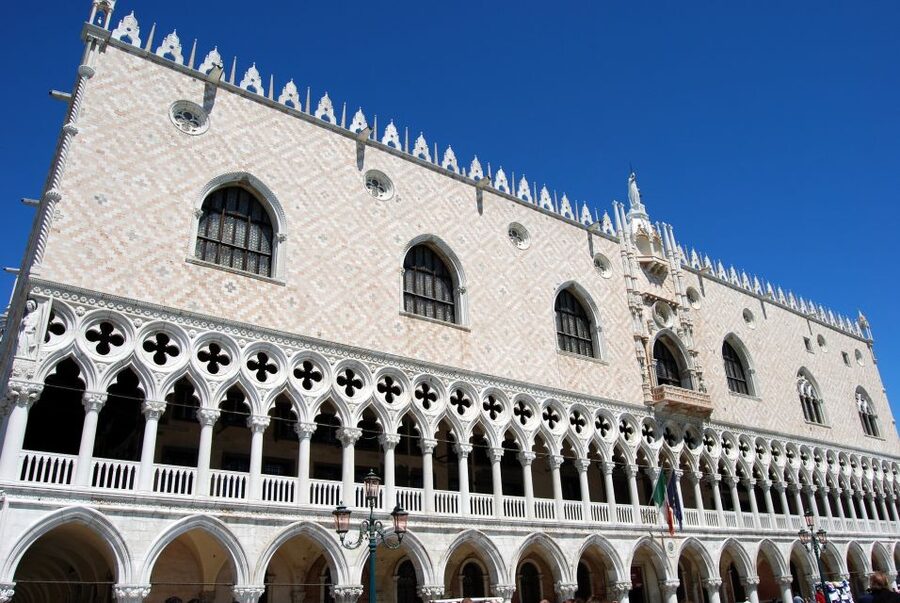
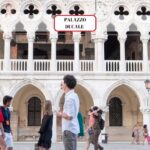
Doge’s Palace is the kind of place that can overwhelm you if you enter cold. This tour helps by getting you positioned first with the plaza landmarks and story context. Then you skip the long ticket lines and go into one of Venice’s most powerful symbols.
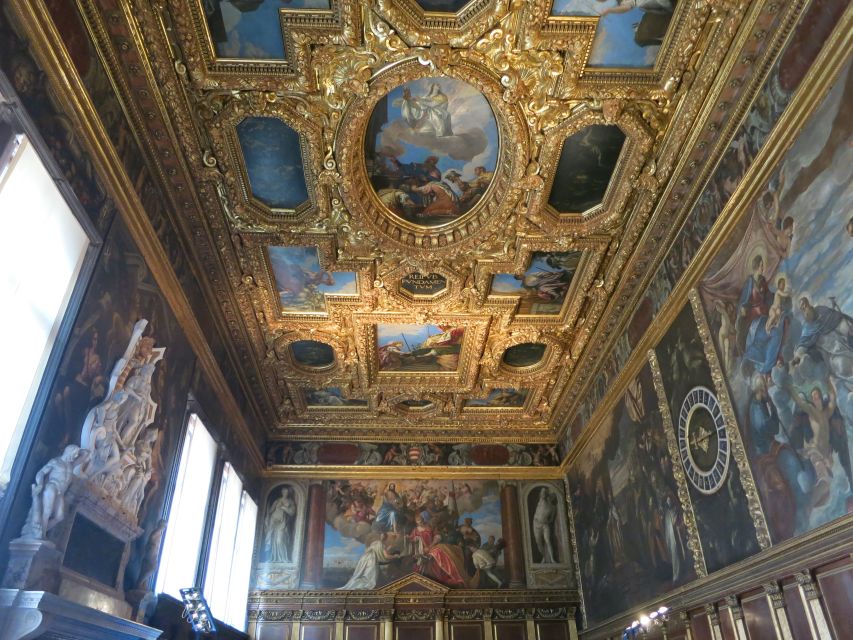
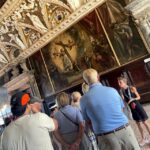
Inside, you’ll explore the rooms that served as the seat of Venetian political power for centuries. The tour frames it in a clear way: you’ll encounter hundreds of masterpieces of art, and the sheer scale and decorative intensity are meant to take your breath away.
Now for the reality check. Even with skip-the-line access, plan for security measures and checks at entry. The tour’s wording is clear that you may still experience expected waits due to security procedures. On bank holidays or special dates, you should also expect bigger crowds.
My practical advice: treat the skip-the-line as time-saved, not time-guaranteed. When security is busy, it’s busy for everyone. The win here is you’re usually not stuck in the worst part of the queue.
Also note: you’ll need an ID or passport, and you shouldn’t bring luggage or large bags. St. Mark’s Basilica is strict about bag rules too, so keep your load light.
St. Mark’s Basilica: Saint Mark, Gold Mosaics, and the Pala d’Oro
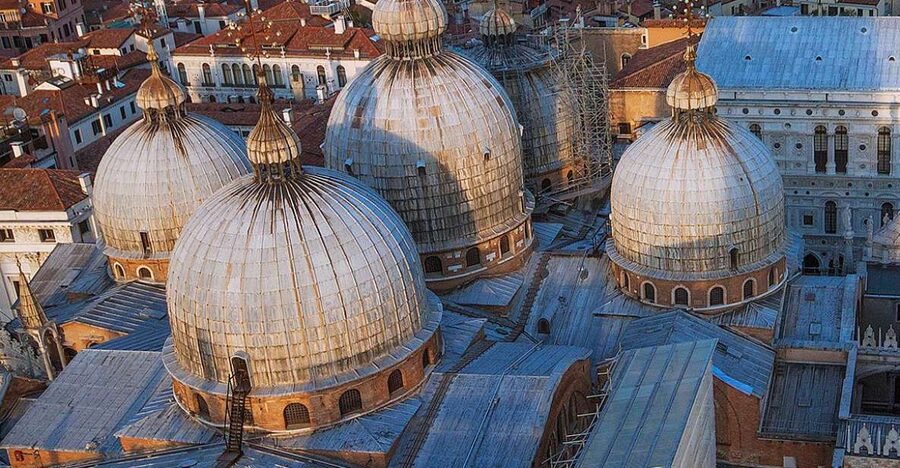
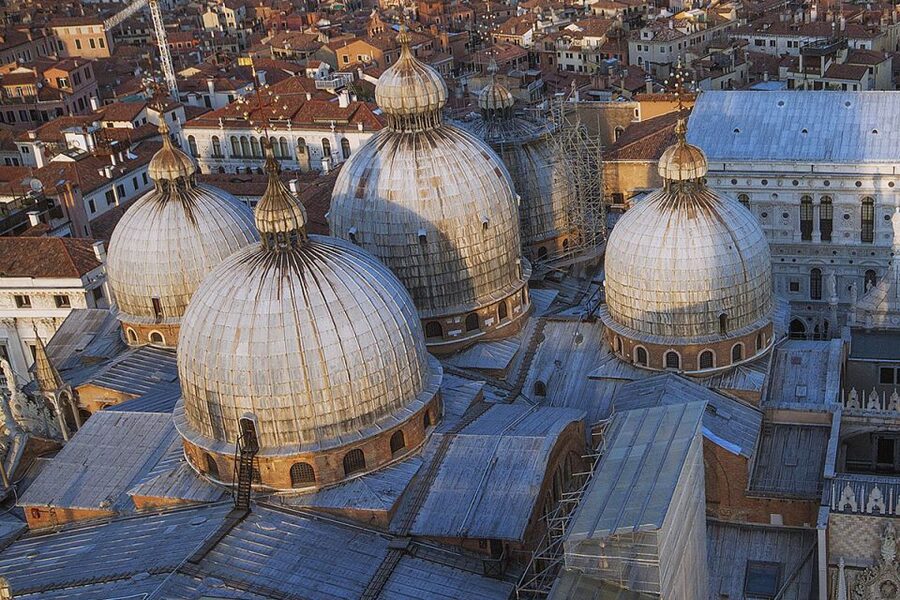
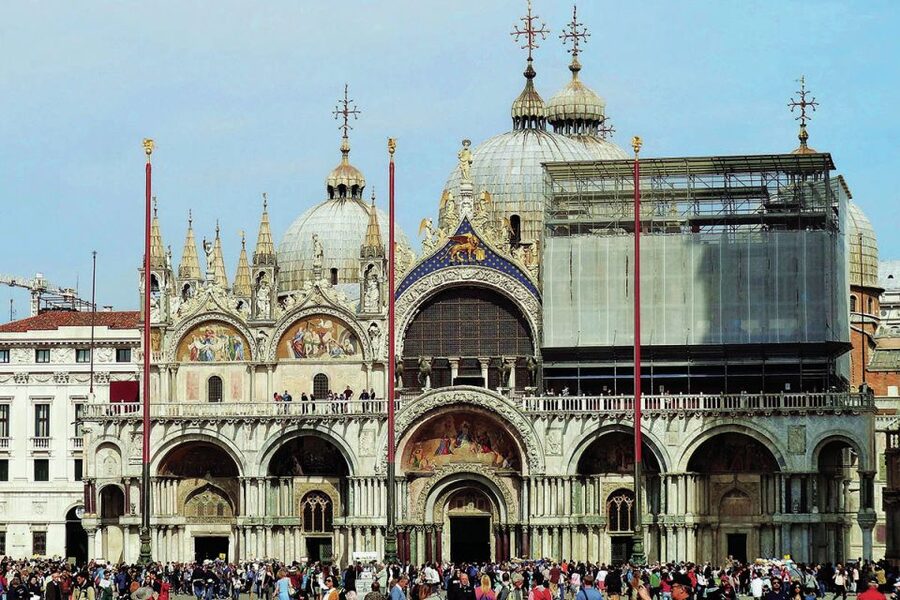
After Doge’s Palace, the tour moves you into St. Mark’s Basilica, described as a Byzantine monument and one of the most iconic religious spaces in Europe. You’ll learn about Saint Mark and how his ruins came to rest here, which is the kind of story that makes the building feel less like decoration and more like belief.
Then you get the big visual payoffs. Expect to see gold mosaics and marble inlays, and you’ll learn the history of the architectural masterpiece and its priceless treasures. If you’ve only seen photos, the key surprise is how much light and detail bounce around inside. It’s not just pretty; it’s structured so the whole space communicates power and sacred authority.
From there, you’ll go to the Treasury to look at religious art, including the Pala d’Oro. The tour highlights this as gem-encrusted and notes thousands of gems and precious stones. That level of description matters because it’s easy to treat the Treasury as a quick add-on. It’s not. It’s where the meaning of all that symbolism becomes painfully concrete: materials, craft, and devotion all in one.
Dress code reminder you should not ignore: you’ll need appropriate clothing for St. Mark’s Basilica, with no bare knees or shoulders. You don’t want to be scrambling at the entrance.
And since the experience includes skip-the-line access here too, you still may run into security checks. Same logic as Doge’s Palace: it saves time, but it doesn’t erase the checkpoints.
Price and Timing: Is $142.74 Worth It?
At $142.74 per person, this tour isn’t a “budget stroll.” But it does combine two expensive time sinks—Doge’s Palace and St. Mark’s Basilica—with a guided walk that fills in the gaps between them.
Here’s how I think about value for you:
- You’re paying for a guide plus entrance ticket to Doge’s Palace and skip-the-line access for both Doge’s Palace and St. Mark’s Basilica.
- You also get external orientation on Piazza San Marco landmarks (Clock Tower and Procuratie) and stops that explain Venice beyond the two headline interiors.
- The time commitment is tight and efficient: 4 to 4.5 hours. That matters in Venice, where getting from one end of the city to another is slower than it looks on a map.
If you were planning to do Doge’s and St. Mark’s on your own, you’d spend time figuring out logistics, choosing when to go, and reading enough context to make the art land. A good guide speeds up all of that. That’s the main reason this price can feel fair.
One more timing note: starting times vary by availability. If you can, pick a departure that reduces crowd pressure. And whatever you do, aim to arrive early at the meeting point on Piazza San Marco.
Meeting Point Reality Check: Maps, Radios, and Group Flow
The tour starts on Piazza San Marco, but the exact meeting point can vary depending on the option booked. This is where you can save yourself stress: don’t rely only on a single map pin. It’s smart to cross-check signage or the final instructions you receive and arrive with a few extra minutes.
Inside the experience, there’s also a practical side to group tours in Venice. It’s a lot of moving in tight spaces, and guides often use radio headsets for better sound. If a headset setup feels uncomfortable, just adjust your grip or placement so you can focus on the guide’s words instead of fighting the gear.
Quality of guiding matters for this one. Some guides are noted for being passionate and clear, like Cynthia, who has been praised for knowledge plus practical considerations that make the walk easier and more memorable. On the other hand, if you struggle to catch words when someone is speaking softly, stand closer to the guide and ask for clarification if needed.
No one wants to lose momentum. If the group is reorganizing after access controls, you’ll want to stay aware of where everyone’s heading next.
Who Should Book This Tour
This is a great choice if you want:
- The core Venice icons in a single morning or afternoon block
- A guide to connect politics, art, and religion instead of treating each site as separate
- A walk that includes quieter Venice street life between the big interiors
It’s not the best fit if you need wheelchair accessibility, since it isn’t suitable for wheelchair users. Also, if you hate dress-code rules, St. Mark’s Basilica can force last-minute changes.
If you’re traveling with limited time in Venice, this route helps you get the most recognizable symbols without wasting your day in queues.
Should You Book This Venice Walking Tour?
Book it if you want an efficient, guided route that pairs skip-the-line access with context. You’ll get Doge’s Palace and St. Mark’s Basilica with a narrative thread that makes the art and symbols feel connected, plus street time that shows Venice as a living place.
Skip it or consider a different format if:
- You’re extremely sensitive to delays from security checks at major entrances
- You need totally silent, self-paced sightseeing (this is a guided group walk)
- You might struggle with the St. Mark’s dress requirements
If you do book, set yourself up for success: wear comfortable shoes, bring your ID, keep bags minimal, arrive a bit early in Piazza San Marco, and dress with St. Mark’s rules in mind.
FAQ
FAQ
How long is the Full Venice Walking Tour: Doge’s Palace and St. Mark’s?
The tour runs about 4 to 4.5 hours. Exact starting times depend on availability.
Where does the tour start?
It starts on Piazza San Marco. The meeting point may vary depending on the option you book.
What’s included in the price?
You get entrance ticket to the Doge’s Palace, skip-the-line access to the Doge’s Palace and St. Mark’s Basilica, and a live guide.
Do I need to buy tickets for Doge’s Palace or St. Mark’s Basilica?
No separate tickets are required for these included entrances because your price includes the Doge’s Palace entrance ticket and skip-the-line access for both sites.
What should I bring?
Bring a passport or ID card and wear comfortable shoes.
Are there dress rules for St. Mark’s Basilica?
Yes. You need appropriate clothing for entry, with no bare knees or bare shoulders.
Is this tour wheelchair accessible?
No. It is not suitable for wheelchair users.