REVIEW · BANGALORE
Old Bangalore Historical Walk thro Palace, Temples, Fort & Market
Book on Viator →Operated by Bangalore and Beyond · Bookable on Viator
Walking old Bangalore feels like time travel. In just a few hours, you get a guided sweep through Tipu’s teak palace and the streets around it, then slow down for temple stops and the sensory overload of working markets. The payoff is not just dates and stones. You also learn how people pray, trade, and live in the oldest parts of the city.
I especially like the pace: long enough to see details, short enough that you are not stuck in one place all day. And the guide style matters here, with past guides like Vasuki, Raghavendra, and Vanaja known for clear explanations and practical tips (including camera pointers). One possible drawback: temple entry depends on working hours and seasonal changes, and you need shoulders-and-legs covered—ladies should bring a scarf.
In This Review
- Key Things to Know Before You Go
- Old Bangalore on Foot: How the 3 to 4 Hour Walk Actually Feels
- Tipu Sultan’s Summer Palace: Teak Wood and Islamic Architecture
- Kote Venkataramana Temple: 1690 Carvings in a Quick 30 Minutes
- Bangalore Fort: What’s Left of the 16th-Century Founding
- Sri Krishnarajendra Market: Fruit, Flowers, Vegetables, and Real Street Energy
- Shri Adinath Jain Shwetamber Mandir: Quiet After the Noise
- Price and Value: What You Actually Get for Around $22
- The Guide Makes the Difference: Pacing, Stories, and Photo Help
- Practical Tips That Keep the Walk Smooth
- Should You Book This Old Bangalore Walk?
- FAQ
- FAQ
- How long is the Old Bangalore Historical Walk?
- What is the meeting point for the tour?
- Where does the tour end?
- What does the tour cost?
- Is entry to temples and monuments included?
- Are tips included in the price?
- Is hotel transport included?
- What should I wear for the temple stops?
- How big is the group?
- What is the cancellation policy?
Key Things to Know Before You Go
- A small group (max 10) keeps the walk from turning into a slow herd.
- A licensed, Govt. of India-approved guide helps you connect the palace, temples, and fort remnants.
- Tipu’s Summer Palace in teak wood is a standout, with Islamic-style architecture.
- Two faiths, one route: a Hindu temple stop and a Jain temple stop for real contrast.
- Bangalore Fort in perspective: only about 5% of the original fort remains open to visitors.
- You finish near Chickpet metro, which makes it easier to keep moving after the walk.
Old Bangalore on Foot: How the 3 to 4 Hour Walk Actually Feels

This is a short, focused walking tour of central Bangalore, built around a simple idea: see the city’s layers in the same outing. You start at Tipu Sultan’s Summer Palace area and end at a Jain temple near Chickpet metro. Between those points, you move from palace to temple to fort leftovers, then straight into a working market zone.
The group stays small, with a maximum of 10 travelers, so your guide can handle questions as you go. You also get a mobile ticket, which is handy in a place where paper tickets can feel like extra work. The tour time is about 3 to 4 hours, which fits a tight schedule better than long half-day sightseeing blocks.
One more thing that shapes the experience: you are walking through streets with sellers, buyers, vehicles, cows, workers, and plenty of noise. That is the point. It is not a quiet museum route. It is old Bangalore as it is lived, not staged.
You can also read our reviews of more tours and experiences in Bangalore.
Tipu Sultan’s Summer Palace: Teak Wood and Islamic Architecture
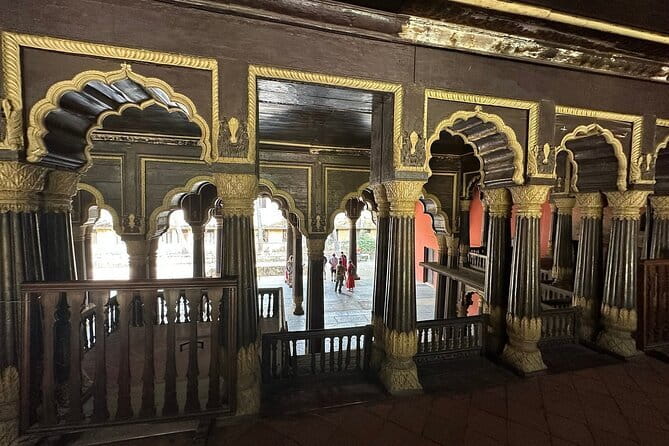
Your first stop is Tipu Sultan Fort and Palace, meeting at Tipu Sultan’s Summer Palace on Tippu Sultan Palace Road in Kamalanagar. This is the big architecture moment: a palace said to be about 230 years old, built out of teak wood. It also shows typical Islamic architecture, which gives the site a different feel than the Hindu temple carvings you will see later.
Time here is around 45 minutes, and entry is included. That duration matters. A teak-wood building can look detailed from every angle, but you do not need hours to notice the style shift. With a good guide, you learn what to pay attention to instead of just snapping photos and moving on.
A practical note: since entry is tied to working hours and seasonal conditions, you should treat this first palace stop as the anchor. If something shifts due to timing, the guide will still keep the walk’s flow.
Kote Venkataramana Temple: 1690 Carvings in a Quick 30 Minutes

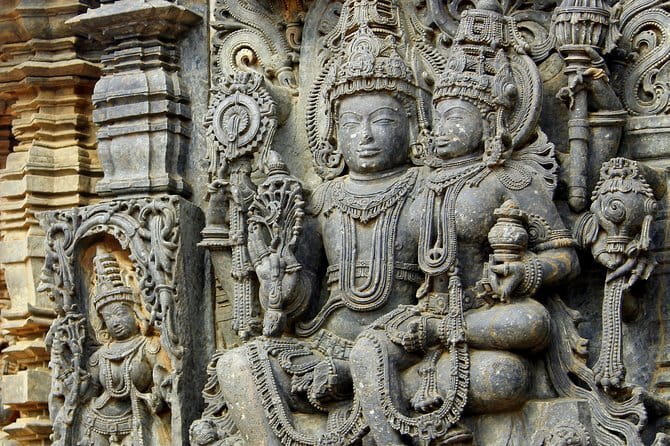
Right next door, you visit Kote Venkataramana Temple, built in 1690 AD by Chikkadevaraja Wodeyar. This stop is shorter at about 30 minutes, but it is packed with stone sculpture work—mythological figures carved into the temple walls.
The reason this stop works well in the itinerary is contrast. Tipu’s palace gives you Islamic architectural form in teak wood. Then you step into a Hindu temple setting where you can focus on stone carving style and mythological storytelling carved into the structure.
Entry is listed as free, and the temple visit is wrapped into the guided flow so you do not lose time figuring out what matters. If you like art that rewards close viewing, this is the kind of stop you will wish you had more time for. If you do not, the guide still helps you catch the key points quickly.
Bangalore Fort: What’s Left of the 16th-Century Founding

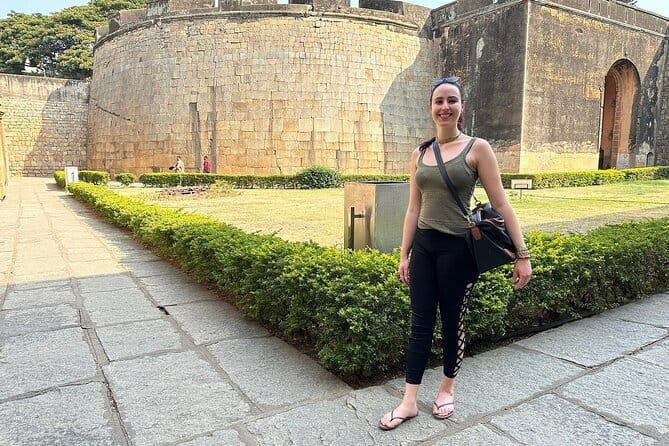
Next comes Bangalore Fort, tied to the city’s origin story. The founder Kempegowda built a mud fort in the 16th century, and later it was rebuilt in stone by Hyder Ali in the 1760s. Here is the reality check: only about 5% of the fort remains and is open to visitors.
A lot of people bounce off ruins because they expect a full structure. This stop is different. It is useful because it forces you to see how cities change. You are not reading an intact fortress; you are reading a remnant and learning what the original site meant.
The visit is about 30 minutes and entry is free. It is a good breathing point before the market, especially if you have been looking at carvings. The guide’s job here is to connect the visible leftovers to the bigger timeline, so it feels like history rather than just a few walls.
Sri Krishnarajendra Market: Fruit, Flowers, Vegetables, and Real Street Energy
Then you shift gears fast. Sri Krishnarajendra Market (also described in the route as the KR Market area) is where the senses get loud.
You are given about 1 hour here, and entry is free. This is a working market, so expect vendors, workers, hawkers, and buyers moving in and out of the flow. The route description also notes the constant presence of animals (including cows and dogs), plus cycles and everyday transport.
This is the stop that makes the walk feel like Bangalore. The guide helps you read the scene: not just what is for sale, but how market life shapes the streets. If you like photography, this is where your images will look the most real—close, noisy, and full of motion.
The main drawback is also part of the charm: it can feel crowded and chaotic. If you are sensitive to noise, you might find this the hardest stop. Still, with a guide steering your route, you can keep it fun instead of stressful.
Shri Adinath Jain Shwetamber Mandir: Quiet After the Noise

The final temple stop is Shri Adinath Jain Shwetamber Mandir, where you get about 1 hour. This is a calm ending after the market. The temple is described as having quietude, carvings, and inlay work, and it shifts your focus from street life to religious practice and temple art.
Jainism is explained as one of the oldest religions of the world, with at least 2500 years of history, and a religion originating in India. The principles highlighted include non-violence, and the setting is meant to make you slow down rather than just look around.
Like the Hindu temple earlier, dress matters. The tour asks for covered legs and shoulders, and for ladies to carry a scarf. Plan to have that ready so you do not lose time at the entrance.
This stop also ends your walk near Chickpet metro station (close by), which is convenient if you want to continue exploring without long taxi negotiations.
Price and Value: What You Actually Get for Around $22

The price is listed at $22.38 per person. That might sound like “just a walking tour,” but the value is more than the walking.
Here is what you are getting that you might otherwise pay for separately:
- Entry fees at all monuments are included.
- You also get a licensed guide to connect the dots between palace, temples, fort remains, and market life.
- The group stays limited (max 10), which usually means you get more attention per person than big bus tours.
What is not included:
- Tips/gratuities to the guide are not included.
- Lunch is not included.
- Transport to and from the walk is not included in the base price, though hotel pickup/drop-off can be arranged for a small additional fee.
So if you are doing this as a half-day cultural hit, it is strong value because you are paying for access and guidance at multiple stops, not just strolling past sights.
The Guide Makes the Difference: Pacing, Stories, and Photo Help
A tour like this lives or dies on the guide. In past runs, guides such as Vasuki, Raghavendra, and Vanaja are described as clearly explaining details and answering questions. There is also mention of insider stories that make the route feel connected rather than like five separate stops taped together.
You can also tell when a guide has thought about pacing. One common theme in the guidance style is that the walk hits the right timing—enough time to see each place, not so long that you end up rushing at the last temple.
If you care about photos, you will like that some guides share practical photo tips before or during the stops. That is the kind of help that improves results fast, especially in markets where lighting and movement can be tricky.
And because the tour ends near Chickpet, the better guides also help you plan what comes next, instead of just dropping you at a landmark and disappearing.
Practical Tips That Keep the Walk Smooth
Before you go, keep these in mind.
Dress code for temples: Cover your legs and shoulders, and ladies should bring a scarf. Since the route includes a Hindu temple and a Jain temple, you want clothing that works for both.
Temple timing can shift: Entry is subject to working hours and seasonal variations. That means you should expect the guide to manage timing and adjust on the ground if needed.
Hotel transport is optional: If you want the easiest start, you can arrange transport from your hotel to the walk venue and back for a small additional fee. You just need to share which hotel you are staying at.
Small group helps: With a max of 10 travelers, you can ask questions and keep moving. It also means the guide can guide you through busy areas without losing everyone.
Should You Book This Old Bangalore Walk?
Book it if you want a short, high-impact mix of palace + temples + fort remnants + a working market. It is ideal for first-timers who feel like Bangalore’s older center is hard to navigate alone. It also suits people who like contrasts: teak-wood palace forms, carved temple walls, fort leftovers, then the full sound-and-smell of the market.
Skip it (or at least think twice) if you dislike noise and crowds. The market stop is intentionally lively, with plenty going on around you. Also, if you cannot follow the dress code, you will likely feel rushed at the temple entrances.
If you are on a tight schedule, this is one of the best ways to feel old Bangalore in a single session without trying to DIY everything.
FAQ
FAQ
How long is the Old Bangalore Historical Walk?
It runs for about 3 to 4 hours.
What is the meeting point for the tour?
The tour starts at Tipu Sultan’s Summer Palace, 42, Tippu Sultan Palace Rd, Kamalanagar, Chamrajpet, Bengaluru, Karnataka 560018, India.
Where does the tour end?
It ends at Shri Adinath Jain Shwetamber Mandir on Chickpet Rd, Ragipet, Mamulpet, Chickpet, Bengaluru, Karnataka 560053, India, close to Chickpet metro station.
What does the tour cost?
The price is $22.38 per person.
Is entry to temples and monuments included?
Yes. Entry fee at all monuments is included.
Are tips included in the price?
No. Tips/gratuities to the guide are not included.
Is hotel transport included?
Transport from hotel to walk venue and back is available for a small additional fee, but it is not included in the base price.
What should I wear for the temple stops?
You should cover your legs and shoulders. Ladies need to carry a scarf.
How big is the group?
The maximum group size is 10 travelers.
What is the cancellation policy?
Free cancellation is allowed up to 24 hours in advance for a full refund.