REVIEW · LISBON
Setúbal,Sesimbra & Palmela – Private tour, Nature & Culture
Book on Viator →Operated by The Guru Guide · Bookable on Viator
If your idea of a great day is sea air plus real Portuguese sites, this route fits. You’ll move from hilltop castles to Setúbal’s fish market vibe, then out toward Arrábida Natural Park for coastline views and quiet beaches.
I especially love the way this tour mixes nature and culture without feeling rushed in the wrong places. The guide on my itinerary, Hugo from Guru Tours, was warm, easy to talk with, and clearly loves what he’s showing you.
One consideration: it’s a long stretch of sightseeing for a single day (about 7 to 8 hours), and some spots sit on slopes. Plan for comfortable shoes, and if you get heat easily, bring sunscreen and water.
In This Review
- Key things I’d bet on before you go
- A day trip that stitches Portugal together: hills, fish, and sea views
- Palmela Castle: the hilltop stronghold with a strong view
- Setúbal’s Mercado do Livramento: fish market culture in a pretty interior
- A quick stop for local crafts at SetúbalSouv
- The Church of the former Monastery of Jesus: Manueline architecture you can feel
- Forte de São Filipe: your best “wow” viewpoint in Setúbal
- Serra da Arrábida: crystal-clear sea color and viewpoints worth the ride
- Portinho da Arrábida: calm water, a small beach town feel, and diving-friendly waters
- Castelo de Sesimbra: medieval walls and sea views that stay medieval
- Fortaleza de Santiago and the Sesimbra Maritime Museum link
- Cabo Espichel Sanctuary: coastal legend plus 18th-century architecture
- National Cristo Rei: your last big panorama over Lisbon and Almada
- Price and value: why $90.31 feels fair for this much coordination
- Who this tour suits best (and who should pick something else)
- Should you book the Setúbal, Sesimbra & Palmela private tour?
- FAQ
- What’s the duration of the tour?
- How much does it cost per person?
- What time does the tour start?
- Is pickup included?
- Where does the shared tour meet?
- What language is the tour offered in?
- Are there admission fees for the stops?
- Is lunch included?
- How big is the group?
- Do I get anything on the vehicle?
Key things I’d bet on before you go
- Hugo’s guiding style: friendly, detail-minded, and the day feels personal without being heavy-handed
- Hilltop forts and castles: big views from Palmela and Sesimbra, plus an easy walk along walls in places
- Arrábida Natural Park stops: sea-meets-rock views, with time for the Portinho da Arrábida beach area
- Manueline architecture at Jesus Church: one of the architectural milestones that shaped Portuguese design
- Free entry for the listed stops: you won’t have to budget ticket costs for each point
- Small group limit (max 16): better flow than a giant bus day, even with shared pickup options
A day trip that stitches Portugal together: hills, fish, and sea views
This is the kind of route that makes Setúbal, Sesimbra, and Palmela feel like one connected story. You start inland at the highest defenses on the map, then slide down into the working life of Setúbal, and finish with coastal sanctuaries and maritime fortifications.
You’ll also appreciate the pacing. The day is built around short, focused visits—enough time to see what matters, then move on before you lose your energy.
And yes, this is priced like a full-guiding experience, not just a ride to a few viewpoints. With the air-conditioned vehicle, WiFi on board, and monument guidance included, you’re paying for comfort and someone to help you notice what you’d otherwise miss.
You can also read our reviews of more tours and experiences in Lisbon.
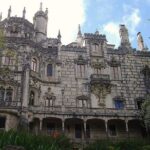

Palmela Castle: the hilltop stronghold with a strong view
Palmela Castle sits at one of the highest points in Serra da Arrábida. That elevation matters. In the past, it made sense as a territorial defense location because the terrain itself did the hard work for the fortifications.
What I like here is the clear sense of purpose. You’re not just looking at stone; you’re seeing how a medieval strategy played out in real geography.
A few historical anchors make the visit click:
- During the Christian Reconquista under D. Afonso Henriques, Palmela sat on a defense line south of the Tagus.
- The Order of Sant’Iago da Espada became part of the castle’s role in the 1100s–1200s.
- In the 1400s, D. João I ordered restorations and the convent that later became the seat of the Order from 1443 onward.
- The Santiago religious community remained there until the extinction of religious orders in 1834.
Practical note: the information emphasizes that access is difficult, which is common for hilltop castles. The good news is that you’re visiting as part of a guided route with planned timing, and the stop length is around 45 minutes.
If you’re the type who likes seeing why a place is where it is, this is your first win of the day.
Setúbal’s Mercado do Livramento: fish market culture in a pretty interior
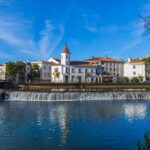
Setúbal’s Mercado do Livramento is a great palate cleanser after the hilltop fortress. This market was opened in 1930 to replace an earlier one demolished in 1876, and it underwent a full interior remodel with renovations carried out between 2010 and 2011.
Inside, the tile panels do a lot of the storytelling. They depict Setúbal’s economic activities, designed by Portuguese engraver and painter Pedro Pinto (from 1929). At the north entrance, there are additional panels by Rosa Rodrigues (from 1944), also showing scenes of the city.
This stop is worth your time even if you don’t plan to buy anything. It gives you the local rhythm—what people traded, what the city built its identity around, and why this place is still in use.
The timing is short (about 30 minutes), and entry is listed as free, so you can enjoy it without turning it into a chore. If you’re a photo person, go for wide shots of the interior first, then close-ups of the tile work.
A quick stop for local crafts at SetúbalSouv
Next is a smaller, more relaxed interlude: SetúbalSouv, a local souvenir shop made by artisans. The standout detail is the fish-shaped building made of cork and wood.
This is the sort of stop I like when a day includes lots of stone. You get texture, color, and something handmade. It’s also a simple way to pick up a small item without hunting around on your own.
The visit is brief (around 15 minutes), and entry is free. Treat it as a chance to browse, not a pressure stop.
The Church of the former Monastery of Jesus: Manueline architecture you can feel

Then you move into one of Portugal’s architectural turning points. The Convent and the Church of Jesus are described as landmarks that mark the beginning of the Manueline style.
The works started in 1490 and apparently ended around 1496, with Diogo Boitaca leading the project. His name matters because it links this church to other big Portuguese monuments from the same era, like the Jerónimos Monastery, Belém Tower, and Batalha Monastery.
What makes this stop practical is that you’re given a way to understand what you’re seeing:
- The Church of Jesus is considered an early attempt at a church-hall in Portugal.
- It’s designed as a homogeneously lit space.
- Inside the convent complex, you get innovative solutions for the time—round arches, vaults based on lowered arches, and rib networks.
The stop is short (about 15 minutes) and admission is free, so you’ll want to focus on the elements your guide points out. If you’re the kind of traveler who likes architecture but doesn’t want a long lecture, this is a good match.





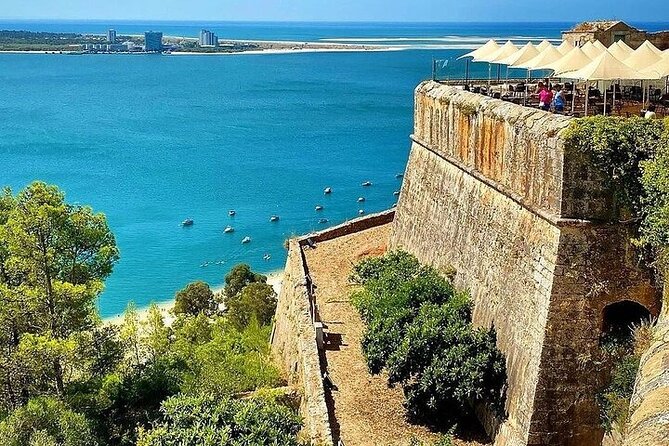
Forte de São Filipe: your best “wow” viewpoint in Setúbal
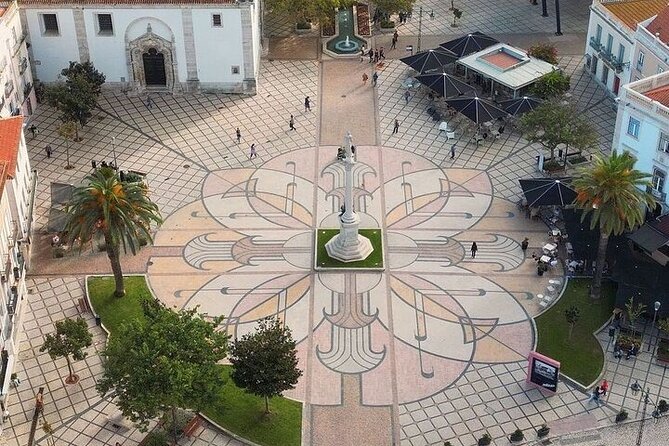
São Filipe Fort is one of those places where the view does half the explaining. Built as a defensive and control bastion, it comes from Spanish monarch Philip II’s orders to fortify the coastline protecting Setúbal and the mouth of the Sado River.
The fort was designed by Captain Fratino in 1583. Its plan is described as an irregular polygon with six-pointed star form and six bastions, and it sits on a steep slope over the sea.
What I appreciate is how the design connects to the threats. The fort had a tactical role in reinforcing a coastal defense line against pirate attacks from northern Europe and Africa.
The real payoff is on the walls. From there, you can see a breathtaking panorama of the city and the bay. The stop runs about 45 minutes, and entry is listed as free.
If you’re sensitive to wind, bring a light layer. Coastal fort walls can feel much cooler than you expect, especially if the day starts sunny.
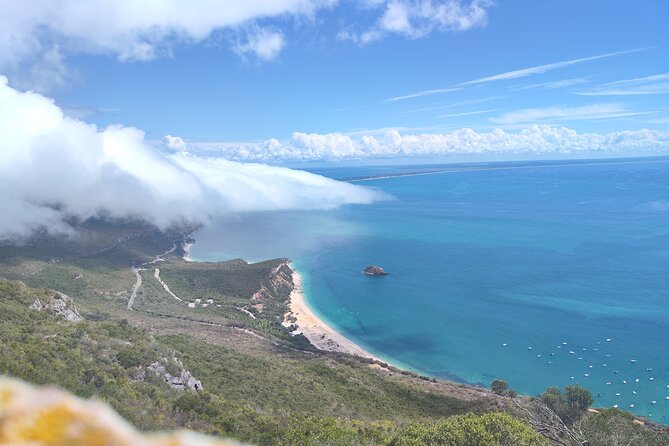
Serra da Arrábida: crystal-clear sea color and viewpoints worth the ride
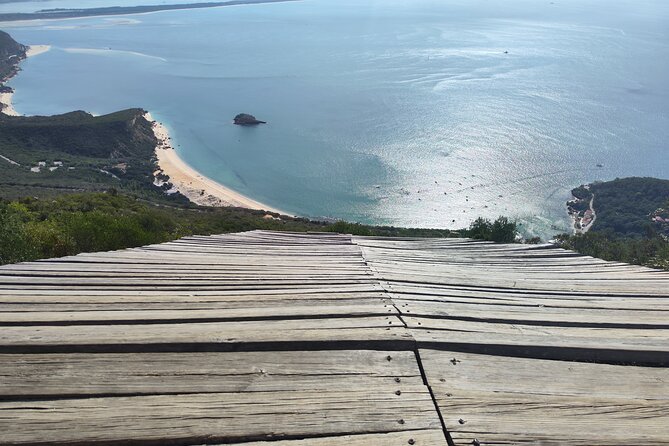
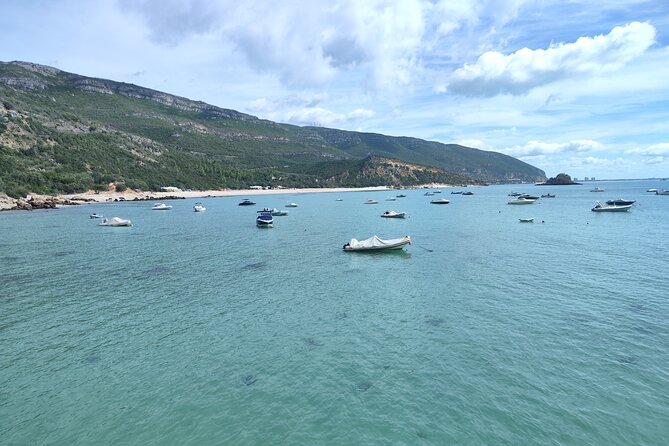
Now you shift from built heritage to natural heritage. Serra da Arrábida, part of Arrábida Natural Park, is where the coast turns postcard-simple: crystal-clear blue waters meeting green nature.
It’s close enough to Lisbon for a day trip—about 45 km from Lisbon—and near Setúbal and Sesimbra. The park covers around 10,800 hectares across Palmela, Sesimbra, and Setúbal, with steep terrain and multiple mountain ranges mentioned in the description.
Your guide’s job here is key. Natural areas can be hard to judge from a bus window, but a short guided visit with specific viewpoints makes it easier to appreciate what you’re seeing.
Stop timing here is about 45 minutes, and entry is listed as free. If you’re traveling in warm months, this part of the day can be very bright. Sun protection matters.
Portinho da Arrábida: calm water, a small beach town feel, and diving-friendly waters
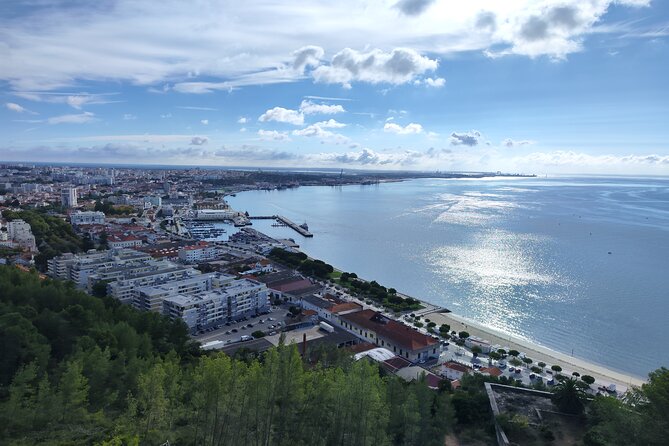
After Arrábida viewpoints, you’ll head to Portinho da Arrábida. It’s a small town area where the beach is the main attraction—Portinho da Arrábida beach—positioned near other beaches like Creiro and Alpertuche.
The water is described as calm and clear, cold, and good for diving. That tells you something important for planning: even if you’re not swimming, you’ll still enjoy the visibility and the clean feel of the coastline.
The beach is rocky with some facilities, including restaurants. In 2010, it received a distinction as one of the 7 natural wonders of Portugal in the beaches category.
This stop is about 30 minutes. It’s a good length: enough to feel the place and take photos, not so long that you lose time for the later Sesimbra sites.
Castelo de Sesimbra: medieval walls and sea views that stay medieval
Back on the defensive theme, Sesimbra Castle is described as the last Portuguese castle on the sea to keep its medieval design. It was classified as a National Monument in June 1910.
The key thing you’ll notice is the wall circuit: you get unique views over Sesimbra and the sea. Inside, there are permanent exhibitions about its history, plus a heritage interpretation center, a church, and a disused cemetery. There’s also a museum circuit designed to let you explore points independently.
The stop is about 45 minutes, and entry is listed as free. If you like walking walls, this is a satisfying switch from the more rugged fortifications in other spots.
A small practical tip: plan your photos for the edges of the walls. That’s where the sea and town meet in a way that feels most “earned.”
Fortaleza de Santiago and the Sesimbra Maritime Museum link
Next comes Fortaleza de Santiago, which has coexisted with the Sesimbra community for 365 years. It was built when danger arrived from the sea, so the function was defense and border protection. Over time, it lost defensive importance—but it didn’t lose its ability to tell stories.
The description emphasizes that it was carefully restored. After specialized restoration work that preserved the initial structure as much as possible, it opened to the public in July 2014.
What I like about this stop is the way the restored spaces help you understand the original functions: you’ll be able to picture how different rooms worked, from magazine areas to the governor’s house and dormitories.
Then the maritime museum connection matters. In 2016, the Sesimbra Maritime Museum was added to the fortress, showing the history of the sea, fishing, and the fishing community from earliest times to today.
This stop is about 45 minutes, entry free. If you care about how communities survive and adapt, the museum angle gives the fort more meaning than just walls and angles.
Cabo Espichel Sanctuary: coastal legend plus 18th-century architecture
Cabo Espichel is where the day’s tone shifts again—toward legend and sacred architecture. The Cabo Espichel Sanctuary, also known as the Sanctuary of Nossa Senhora da Pedra Mua, sits inside the Arrábida Natural Park west of Sesimbra.
It marks the southwestern tip of the Setúbal peninsula, with glimpses toward Lagosteiros Bay. The legend mentions an apparition of Our Lady. You won’t see the primitive sanctuary described by older references, but you will see the later structure tied to the cult of Nossa Senhora do Cabo.
From there, you’ll get a mix of buildings and functions:
- A church built between 1701 and 1707 in a described floor-to-ceiling style.
- Two wings of inns built between 1745 and 1760.
- A water house from 1770, supplied by an aqueduct.
- An opera house dating from the end of the 1800s.
This stop lasts about 1 hour with free entry. That longer time makes sense because there’s more to observe than a quick lookout.
If you’re traveling on a day with strong sun, you may want to pause in shaded areas before you start climbing stairs or moving between buildings.
National Cristo Rei: your last big panorama over Lisbon and Almada
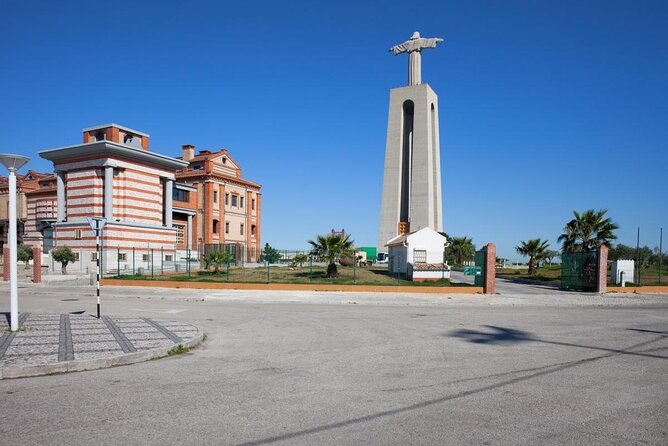
To wrap up, you’ll visit Santuario Nacional de Cristo Rei. The project began in 1940 after Portuguese bishops vowed to build a Monument to the Sacred Heart of Jesus over Lisbon if Portugal was spared from war.
Construction turned into a national fundraising effort, and the monument was inaugurated in 1959. It rises 113 meters over Almada and Lisbon and offers a 360º panoramic view over both banks of the Tagus River and surrounding areas.
Inside the four pillars, there’s the Chapel of Our Lady of Peace, with the image described as a replica offered to the Church of Saint Eugene in Rome during the Holy Year of 1950.
This stop is about 45 minutes and listed as free. It’s a good final viewpoint because it ties the trip back to Lisbon’s larger river setting, and it helps you visualize where Setúbal region sits in relation to the city.
Price and value: why $90.31 feels fair for this much coordination
At $90.31 per person for a 7 to 8 hour private tour experience, the value comes from what’s bundled, not just the sightseeing list.
You’re getting:
- Air-conditioned private transportation
- WiFi on board
- All fees and taxes
- Guided monument visits
- Full insurance coverage
- A driver/guide team that helps you actually understand what you’re looking at
Lunch is not included. That’s the main trade-off. But the tour description also notes you’ll get a selection of incredible restaurants that never disappoint, so you aren’t left guessing.
The other “value factor” is time saved. Hilltop places and coastal routes can be slow without planning. Here, you’re paying for logistics so you can focus on enjoying each stop.
Who this tour suits best (and who should pick something else)
This is a strong fit for you if:
- You want one day that covers castles, forts, markets, architecture, and coastal nature.
- You like guided context, especially when it helps you connect medieval defense, maritime life, and Portuguese styles like Manueline.
- You prefer comfort: pickup options, air-conditioned vehicle, and a small group cap.
It might be less ideal if:
- You’re looking for a long beach day with lots of swimming and minimal walking.
- You dislike long car time. This is a 7–8 hour day, and you will spend time traveling between sites.
If your main goal is only one specific beach, you might do better with a half-day coastal outing. But if you want a full picture of Setúbal/Sesimbra/Palmela, this tour is built for that.
Should you book the Setúbal, Sesimbra & Palmela private tour?
If you want a day that feels like Portugal in layers—defense on the hills, working life at the market, and sea views with architectural stops—then yes, I’d book it.
The deal-maker is the human side. The guide Hugo’s style is repeatedly praised: kind, knowledgeable in the way that makes sites make sense, and genuinely invested in the day. Add in the mix of places and the fact that the listed stops have free admission, and the price starts to feel very reasonable.
One last nudge: wear shoes you’re happy to walk in and plan for a sun-and-wind coastal finish. Do that, and you’ll come away with photos, stories, and a route you can explain to friends without sounding like a brochure.
FAQ
What’s the duration of the tour?
The tour runs about 7 to 8 hours.
How much does it cost per person?
It costs $90.31 per person.
What time does the tour start?
The start time is 9:00 am.
Is pickup included?
Pickup is offered. For private tours, pick-up and drop-off are included in all hotels, local accommodation (including Airbnbs), cruise terminal, and airport.
Where does the shared tour meet?
Shared tour meeting points are Hard Rock Café – Lisbon or Casa da Baía – Setúbal.
What language is the tour offered in?
The tour is offered in English.
Are there admission fees for the stops?
The provided stop details list admission tickets as free for each stop.
Is lunch included?
No. Lunch is not included, and you’ll have restaurant suggestions for places that work well.
How big is the group?
The maximum is 16 travelers.
Do I get anything on the vehicle?
Yes: an air-conditioned vehicle and WiFi on board are included.