REVIEW · SPLIT
History & Cultural Walking Tour of Split and Diocletian’s Palace
Book on Viator →Operated by Ancient Tours · Bookable on Viator
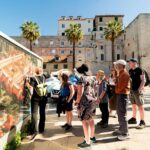
Split starts making sense fast. If you want one efficient way to understand why Split looks the way it does, this History & Cultural Walking Tour connects the dots from Roman power to everyday life in the old city. I especially like the small group size (max 15), because the guide can answer questions without rushing you. And the storytelling stays grounded—Diocletian’s Palace details, plus culture stops around the promenade and squares.
One thing to factor in: this is a walking tour through an old-town setting, and it’s not recommended for travelers who have issues with high steps. If that sounds like you, you’ll need to decide if you can handle uneven stone and changes in level.
In This Review
- Key highlights you’ll actually feel on the ground
- Why Diocletian’s Palace explains Split’s whole layout
- Entering Split’s core: Peristil ulica to the Palace heart
- Peristyle and the palace’s main square: your mental map in 15 minutes
- Vestibulum and the chance for Dalmatian singing
- Diocletian’s substructures: Roman function and how time changes roles
- Golden Gate and Gregory of Nin: architecture meets identity
- Riva Harbor and the palace model: from imperial stone to seaside life
- Fruit’s Square (Trg Brace Radic) and Marko Marulić
- Passing the Split Synagogue: seeing the city’s Jewish layer
- What the guides get right: clarity, pace, and real engagement
- Price and value: why $22.98 often feels fair here
- Logistics that matter: walking pace, transit access, and what to wear
- Should you book this Split Palace history walk?
- FAQ
- How long is the History & Cultural Walking Tour of Split and Diocletian’s Palace?
- Where does the tour start and end?
- Is the tour in English?
- Are admission tickets included?
- What’s the group size limit?
- Is this tour suitable if I can’t handle high steps?
Key highlights you’ll actually feel on the ground
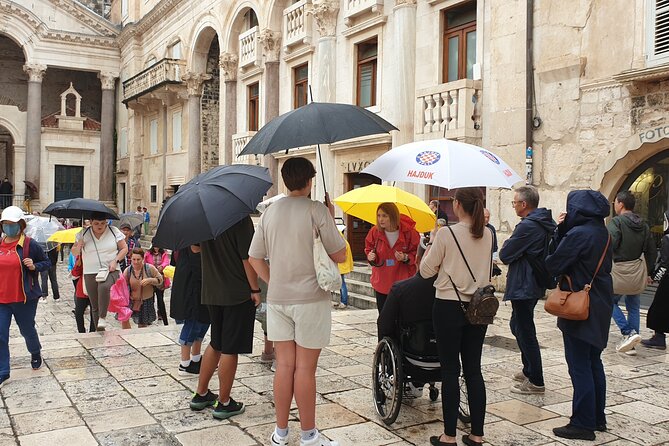
- A max group of 15 keeps it personal, not a loud parade.
- Diocletian’s Palace focus gives you a map in your head before you explore on your own.
- Golden Gate + Gregory of Nin connects an iconic statue to language and identity.
- Riva Harbor + a palace model shows how the Roman city becomes a modern promenade.
- Culture beyond ruins, including a chance to hear traditional Dalmatian singing.
- Free admission at most stops, so your money goes to the guide, not ticket math.
Why Diocletian’s Palace explains Split’s whole layout
Split can feel like a maze at first. You’ll see stone alleys, open squares, and doorways that lead to… more doorways. This tour helps you read that maze like a story, starting with the palace itself—because Diocletian’s Palace isn’t just a monument. It’s the skeleton the city grew around.
You’ll walk inside the UNESCO-listed heart of old Split and learn how a Roman ruler’s complex became the foundation for daily life. That’s the real value here: the guide doesn’t treat the palace like a distant museum piece. Instead, you hear how spaces were designed, what different parts were for, and how later eras reshaped what you see.
Another reason I like this approach is that it’s not only big-picture talk. The stops are timed and planned so you get quick orientation first—then the details start clicking. By the time you reach places like the Golden Gate or Riva Harbor, you’re not just looking. You’re understanding.
You can also read our reviews of more tours and experiences in Split.


Entering Split’s core: Peristil ulica to the Palace heart
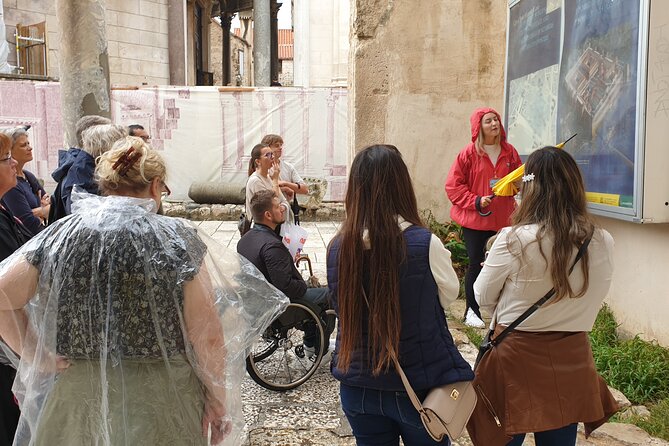
The tour starts back at Peristil ulica (Peristil ul., 21000, Split), and that matters more than it sounds. You’re beginning right where people naturally orient themselves when they’re crossing between the open square and the palace streets.
From the first minutes, you’re moving into the palace zone and your guide sets the rhythm. Because it runs about 1 hour 30 minutes and stays compact, it works well as a first activity in Split—especially if you only have one day or you want to avoid spending hours trying to decode things on your own.
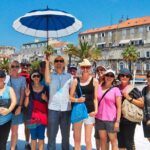
This is also the kind of tour where the group size makes a difference. With a maximum of 15 travelers, it’s easier to hear explanations at street level, at each doorway, and in the open areas. If you’ve ever been stuck at the back of a big group, you’ll appreciate how this keeps you close enough for real context.
Practical tip: wear good walking shoes. Split’s old stone can be slick and uneven, and the “not recommended for high steps” note is your clue that footing and step height matter here.
Peristyle and the palace’s main square: your mental map in 15 minutes
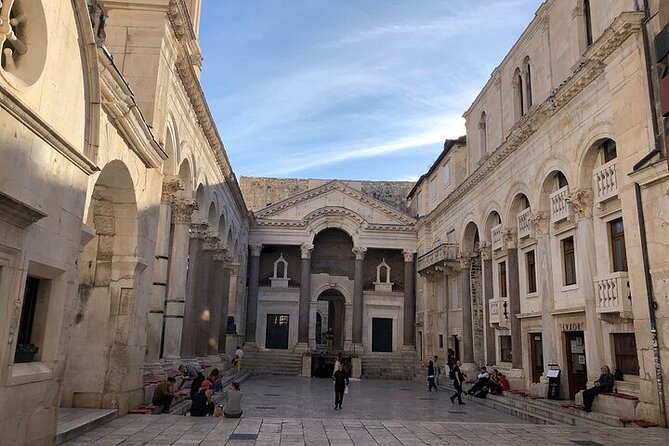
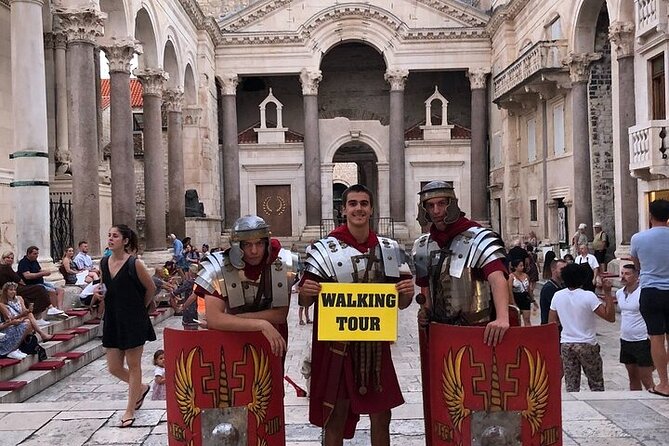
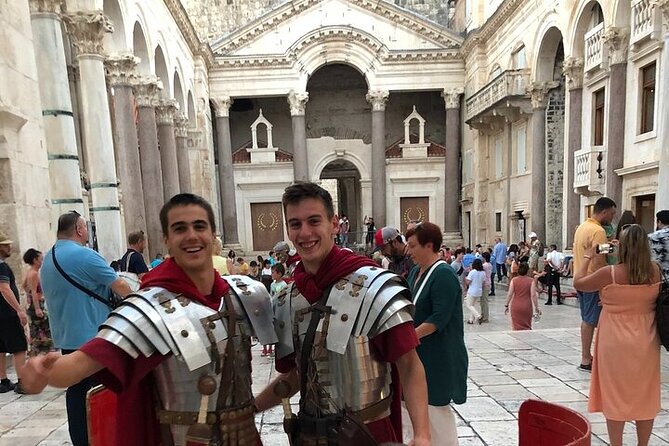
The first stop is the Peristyle of Diocletian’s Palace, the central square of the complex. This is where you get oriented fast. From here, you can reach many other areas within the palace, so it’s the perfect first anchor point.
What makes this moment useful is the way it teaches you to look. Instead of only taking photos, you learn what the space was meant to do and why it’s positioned the way it is. Once you understand how the Peristyle functions as a hub, the rest of the palace stops feel less random.
The admission at this stop is free, which is a quiet win. You can spend your budget on the guide and spend your energy on the experience instead of ticket logistics.
Even if you’re not a “Roman architecture” person, this is the part that usually turns the light on for newcomers. It’s the easiest way to learn the logic behind what you’re walking through.
Vestibulum and the chance for Dalmatian singing
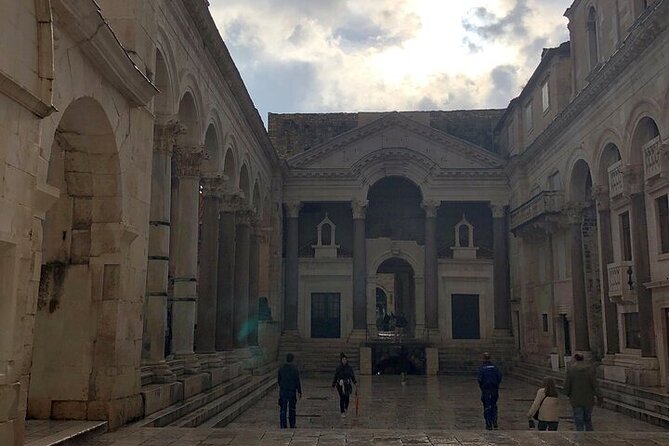
Next you’ll see the Vestibulum of Diocletian’s Palace. This is the vestibule associated with Emperor Diocletian, and it’s positioned to help you understand the palace not only as a set of walls, but as a system of entrances and movement.
This stop is short—about 5 minutes—but that’s intentional. The guide uses the limited time to build context without dragging you through stone. The best part is that you might also hear traditional Dalmatian singing in connection with the stop’s cultural storytelling.
That’s a great contrast to the “only ruins” feeling some tours fall into. Here, the atmosphere is allowed to be human. You’re learning history, but you’re also hearing how culture carries forward in the city’s present.
You’ll get free admission at this stop too, so it’s efficient: you’re paying for the explanation, not for access.
Diocletian’s substructures: Roman function and how time changes roles
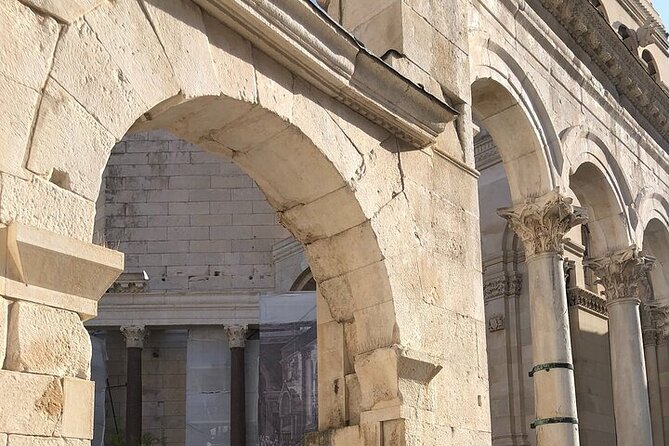
Then you move into the Diocletian Palace Substructures. This area is about what was underneath—and what those lower spaces were used for, and how their roles changed over time.
You’ll spend around 10 minutes here. The key practical detail is that you won’t visit the museum part of the substructures during the tour. That’s not a bad thing; it keeps the walk flowing and prevents the tour from turning into a long indoor detour. If you want more later, you can visit the museum afterward on your own schedule.
Why I think this matters: you don’t want a short tour to swallow you. The guide uses these stops to give you context—then points you toward what you can explore more deeply after you’ve got your bearings.
If you’re the type who likes to return to a place with a better understanding, this structure is ideal. You’ll walk away with enough background to make a museum visit feel purposeful instead of random.




Golden Gate and Gregory of Nin: architecture meets identity
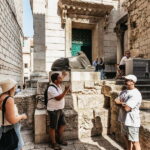
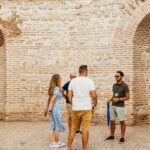
The Golden Gate is one of the most important entrances to Diocletian’s Palace, and you’ll spend about 10 minutes here. This is the point in the tour where the “Roman past” connects to modern Croatian identity.
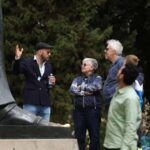
At the Golden Gate area, you’ll learn about the gate itself and see the statue of Gregory of Nin. What the guide emphasizes is Gregory’s importance to history and—specifically—language. It’s a smart way to make the statue more than a landmark. You understand why people care, not just where it is for your camera roll.
This stop is also a nice change in pace. You move from internal palace spaces to a major entrance, so the city feels bigger and more layered. The explanation gives you language for what you’re seeing, and then you’re ready to continue toward the waterfront.
Again, admission at this stop is free—so the “cost” of this part is your attention, not your wallet.
Riva Harbor and the palace model: from imperial stone to seaside life
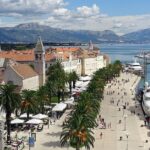
Next comes Riva Harbor, around 15 minutes. Here’s where the tour switches from palace architecture to Split’s everyday postcard reality—the promenade you see everywhere.
You’ll see a bronze model of Diocletian’s Palace, which is one of those visuals that makes the whole experience click. Once you’ve walked through key areas, the model helps you connect the 3D reality to the bigger plan. It’s hard to get that kind of clarity just by wandering alone, especially if it’s your first time in Split.
Then you’ll learn about the history of the Riva promenade—how Split’s waterfront gained its place in the city’s rhythm. The guide’s goal isn’t to turn it into a long lecture. It’s to help you understand why this stretch of water matters so much to daily life and tourism alike.
If you’ve been wondering how a Roman palace turns into a seaside city vibe, this is where you get that answer.
Fruit’s Square (Trg Brace Radic) and Marko Marulić
The tour continues to Fruit’s Square (Trg Brace Radic) for about 10 minutes. This is a cultural pivot point. The focus shifts from Roman structures to later layers—especially the Venetian influence you can trace in the area.
You’ll learn about a 15th-century Venetian citadel and also why Marko Marulić matters. Marulić is described here as the father of Croatian literature, and the guide ties him to why this city produced major cultural voices, not just major buildings.
What I like about including this stop is simple: it prevents the tour from being all stones and dates. Squares and people matter too. You start to see Split as a place where art, language, and identity were shaped right alongside architecture.
It’s also another free-admission stop, so you’re not adding extra costs for what is clearly a meaningful context stop.
Passing the Split Synagogue: seeing the city’s Jewish layer
You’ll also pass the Split Synagogue, a 16th-century site. This is around 10 minutes, and it’s important to know that admission is not included.
Because the tour is walking-focused and time is limited, you may simply pass by and learn the basic historical context—how the Jewish community is part of Split’s story. It’s still valuable, because most Diocletian’s Palace tours focus only on the palace shell. This one adds a broader sense of the city’s human history.
If you want to go inside the synagogue, you’ll need to plan that separately. But even from the outside, you’ll come away with a clearer understanding that Split’s past wasn’t only Roman and Venetian.
What the guides get right: clarity, pace, and real engagement
The biggest reason this tour earns a strong reputation is the guiding style. I like that the explanations stay tied to what you’re looking at right now. You don’t get a vague “it’s old” speech. You get place-specific context and short enough segments that you don’t lose the thread.
In particular, you’ll hear stories and small cultural touches that keep the facts from feeling like a textbook. Guides such as Darko, Ivana, and Ante (Anthony) have been highlighted for being animated, personable, and able to connect architecture to meaning without getting lost in jargon. That kind of guide makes a big difference when you’re moving through tight old streets where you can’t pause for long.
The short stops help too. Each location is treated like a chapter: start with the hub (Peristyle), add an entrance context (Vestibulum), show the hidden layers (substructures), then step out to a city-facing story (Golden Gate, statue context), and wrap with culture and waterfront life (Riva, squares, and the synagogue pass-by).
If you’re a first-timer, this format helps you leave with confidence. If you’re a repeat visitor, it gives you new angles to look for later.
Price and value: why $22.98 often feels fair here
At $22.98 per person, this is priced like an orientation walking tour—not a pricey private guide. The value comes from a few practical details working together:
- Most site stops have free admission, so you’re paying mainly for interpretation.
- The group limit (max 15 travelers) helps ensure you hear and ask questions.
- The duration (about 1 hour 30 minutes) is long enough to feel like a real tour, but short enough to keep your afternoon open for independent exploring.
- The tour offers a mobile ticket, and English is available—useful if you’re traveling with limited language.
Also, the tour can have group discounts, which can make a difference if you’re traveling with friends or family. And since it’s commonly booked well in advance—often around 80 days ahead—booking early helps you lock in a time that fits your day.
One small “value” note: gratuities aren’t included. That’s typical for guided experiences, but it’s still worth mentally budgeting a bit extra if you want to reward good guide work.
Logistics that matter: walking pace, transit access, and what to wear
The meeting point is Peristil ulica, and the tour ends back there. So you don’t have to play guessing games about where your route deposits you. That makes it easier to plan lunch, a museum stop, or a second walk right after.
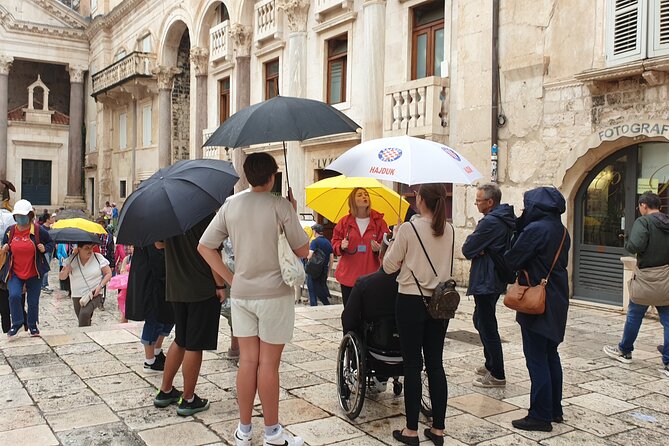
The tour is near public transportation, which helps because Split’s center can be easier to reach on foot once you’re close. Still, you should expect walking. It’s an old city, and even where the tour looks flat on a map, step height and uneven surfaces can surprise you.
Two other practical points:
- Service animals are allowed.
- It’s not recommended for travelers with issues with high steps.
If that’s relevant for you, consider contacting the operator before booking, because old-town routes vary.
Should you book this Split Palace history walk?
If you want a first-night orientation in Split, book it. The short, focused format is ideal for people who want the city to start making sense quickly—especially if Diocletian’s Palace is on your must-see list.
You should skip (or rethink) it if you know you can’t handle steps or uneven stone. And if you already know a lot about Roman palace layouts and you’re only looking for a deep museum visit, you might feel the tour is lighter than what you want—though it does leave you positioned to add museum time afterward at your own pace.
Otherwise, this is a smart, budget-friendly way to get the story behind the stones and walk away with context you’ll keep using all day in Split.
FAQ
How long is the History & Cultural Walking Tour of Split and Diocletian’s Palace?
It runs for about 1 hour 30 minutes.
Where does the tour start and end?
The tour starts at Peristil ulica (Peristil ul., 21000, Split, Croatia) and ends back at the same meeting point.
Is the tour in English?
Yes, it’s offered in English.
Are admission tickets included?
Admission tickets are free for the palace-related stops listed in the itinerary. The Split Synagogue stop has admission not included.
What’s the group size limit?
The tour has a maximum of 15 travelers.
Is this tour suitable if I can’t handle high steps?
It is not recommended for travelers who have issues with high steps.