REVIEW · MARRAKESH
Marrakech: Bahia Palace, Madrasa Ben Youssef and Medina Tour
Book on GetYourGuide →Operated by Moments in Morocco - Tour Agency · Bookable on GetYourGuide
Marrakesh’s masterpieces come with a plan. In 4 hours, you hit Bahia Palace, Ben Youssef Madrasa, the Medina, and Jemaa el-Fna Square in a route that makes sense even if it’s your first day in town. I really like how the tour blends standout architecture (with real craft details, not just photo stops) with guided time in the streets where the city actually moves. One thing to weigh: entry tickets are extra, paid on-site in cash, and you’ll do a fair bit of walking inside the Medina.
The best part is having a good local guide to explain what you’re seeing. Guides often lead with stories and practical context, and they also keep the pace tight enough that you’re not stuck in long, frustrating lines—one of the main reasons this works as a first-or-second day activity. If you end up with guides like Yassine or Mouhssine (names that come up often), you can expect clear explanations and a sense of humor that makes the history easier to hold onto.
My only real caution is timing and expectations around Koutoubia Mosque. You get a great look from the outside, but entry can be restricted during prayer times, and the tour still relies on the day’s monument hours (especially during Ramadan).
In This Review
- Key highlights worth your time
- A smart 4-hour format for first-time Marrakesh planning
- Starting at Café de France in Djemaa el-Fna: where the tour actually begins
- Koutoubia Mosque: an exterior “orientation stop” that pays off later
- Bahia Palace: 19th-century power shown through craft
- Mellah: the short walk that adds context to the Medina
- The souks and craft workshops: learning how products are made
- Ben Youssef Madrasa: quiet architecture, loud beauty
- Medina walking: UNESCO streets that still function
- Jemaa el-Fna at the end: using the square as your “reset”
- Price and value: $19 plus tickets, but you’re paying for time saved
- What the guide style can feel like (and why it affects your day)
- Ramadan timing: build your schedule around earlier closing hours
- Who this tour suits best (and who should think twice)
- Should you book this Marrakech tour?
Key highlights worth your time
- Koutoubia Mosque exterior with a quick architectural orientation before you enter the maze of the Medina
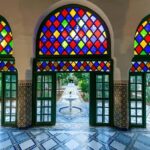
- Bahia Palace interiors and courtyard rooms with floor-to-ceiling plasterwork details you won’t notice on your own
- Ben Youssef Madrasa studied like a living classroom, around a calm central courtyard
- Mellah (old Jewish quarter) as a short stop that adds real context to the city’s multicultural past
- Souk walking with stops for craft workshops so you can watch traditional making in progress
- Skip-the-line support so your time goes to monuments and streets, not waiting
A smart 4-hour format for first-time Marrakesh planning
If Marrakesh feels like a sensory overload at first (it does), this tour is a useful way to get your bearings fast. You start in the most famous public square area—Jemaa el-Fna—then work your way into the parts of the city that explain why it’s famous: palace architecture, an Islamic college (madrasa) built to teach through art, and the Medina’s dense street life.
The schedule also respects attention span. You’re not trying to “do everything” in a full day. Instead, you get focused museum-style time in the palace and madrasa, plus shorter guided walks where you learn how to read the streets.
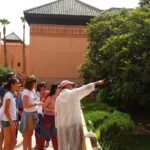
And the guide matters. The tour runs with licensed local guides who keep the group moving, answer questions in English or French, and help with crowd navigation. That combination—good route design plus competent guidance—is why this kind of half-day tour tends to feel smoother than wandering alone.
You can also read our reviews of more tours and experiences in Marrakesh.

Starting at Café de France in Djemaa el-Fna: where the tour actually begins
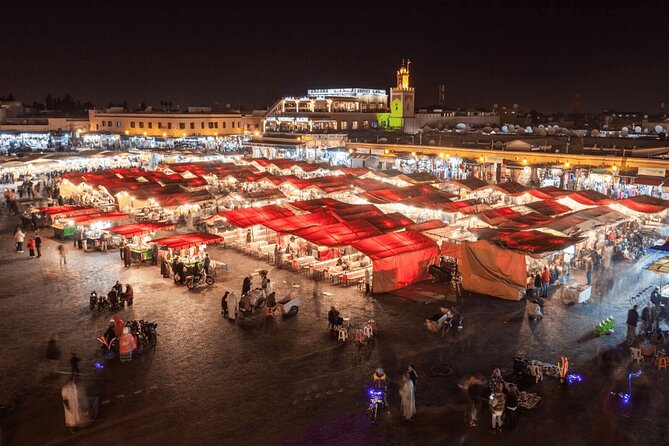
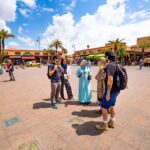
Meet your guide in front of Café de France in Jemaa el-Fna. This is a good choice because it anchors you in a recognizable spot. You also get a reminder setup that includes your guide’s name and the meeting details, plus helpful tips the day before.
What you should do before you go:
- Wear comfortable shoes. The Medina paths are uneven and there’s a lot of stepping in and out.
- Bring water and sunglasses.
- Expect to switch between photo stops and guided inside visits, sometimes with short transitions.
If you choose a private option and you’re staying inside the Medina, hotel pickup can be arranged to meet you at your riad reception. Otherwise, you meet at the café like everyone else.
Koutoubia Mosque: an exterior “orientation stop” that pays off later
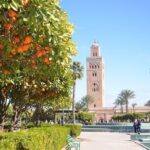
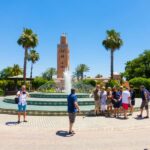
The tour begins with Koutoubia Mosque, Marrakech’s largest and most iconic mosque. Even though you’re not going inside as a general visitor, the stop is still useful because the guide helps you “see” what you’re looking at.
Look for the Almohad architecture cues and the towering minaret crowned with four copper globes—a detail you can often spot from other parts of the city once you know to look.
Two practical notes:
- You’ll do a photo stop plus a brief visit (about 10 minutes).
- Entry to the mosque interior is restricted to Muslims during prayer times, so plan for this to remain an exterior experience.
This is the kind of stop I like on an orientation tour because it gives you landmarks you’ll recognize later while crossing the Medina.
Bahia Palace: 19th-century power shown through craft
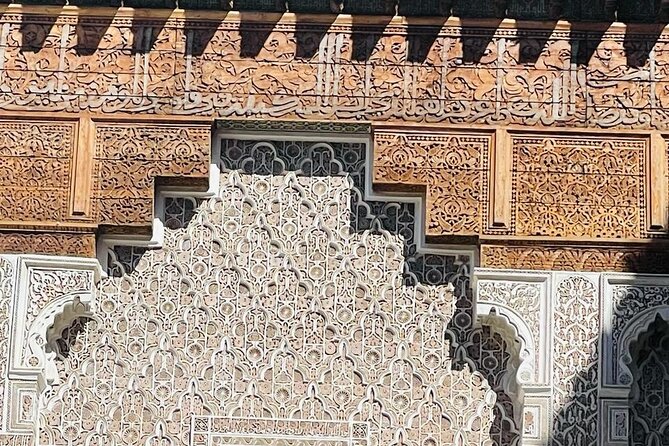
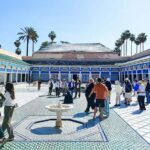
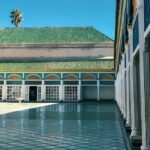
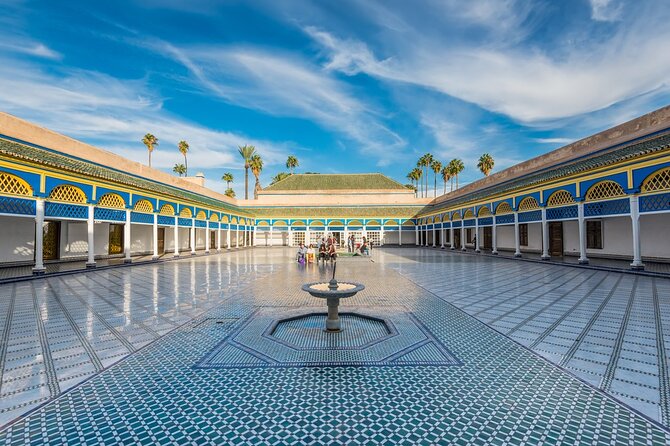
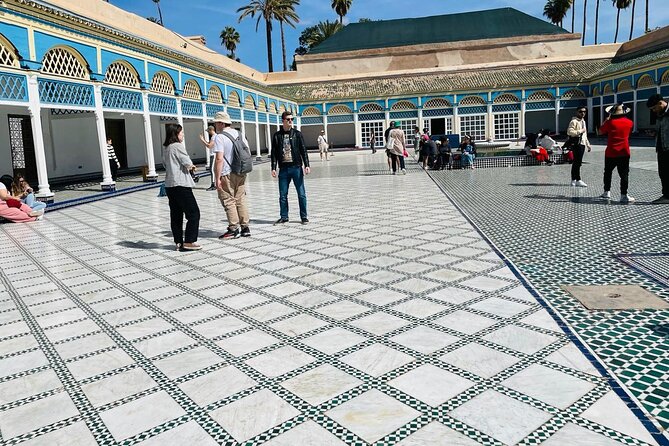
Next comes Bahia Palace, with time to go beyond the first look. The palace is a 19th-century masterpiece built around courtyards, with a complex of rooms that once belonged to the Moroccan elite. You get to see some of that grandeur up close—especially the decorative work that makes Moroccan palace interiors so memorable.
What you’ll notice when you’re inside:
- Ornate rooms with floor-to-ceiling stucco, detailed painting, and mosaic work
- Courtyard design that brings light and air into the palace core
- Carved wood details (including cedar elements mentioned in the tour description) that show how craft was used to project status
The tour allocates about 45 minutes for the palace. That’s enough time to get the main story from your guide, then have real free time to take photos and linger.
One useful expectation: some sections may be under renovation, but you’ll still get the core experience.
Mellah: the short walk that adds context to the Medina
After Bahia Palace, the route includes the Mellah, the former Jewish quarter. This is a brief segment—around 20 minutes, with a photo stop and guided walk—so it’s not a full deep-dive. But it matters because it adds a layer many first-time visitors miss: Marrakesh didn’t develop as one single culture in isolation.
During this stop, your guide helps connect what you see in the neighborhood atmosphere and architecture to the city’s broader multicultural story. You’ll also get practical orientation for how to move through the Medina corridors later without feeling lost.
The souks and craft workshops: learning how products are made
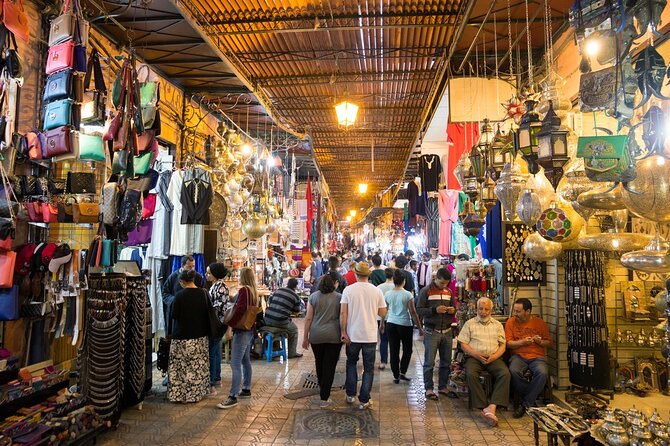
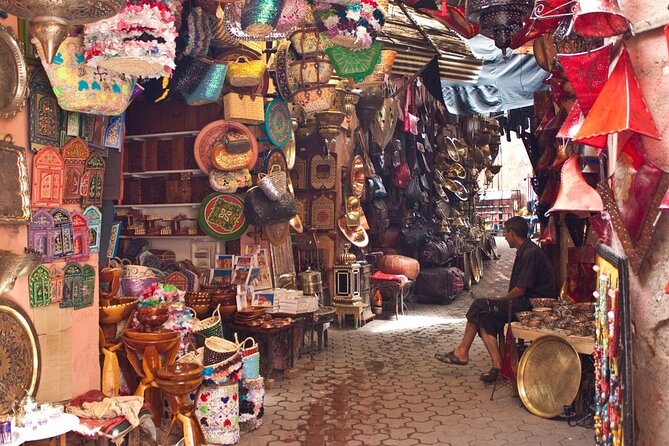
Then you shift into Marrakesh’s trade engine: the souks. This is where the tour becomes more than “monuments and photos.” You’re walking among stalls and sensory details—spices, leather goods, fabrics, and perfumes—while your guide points out how the market system works.
A big plus here is the inclusion of artisan workshops where traditional crafts are demonstrated. Depending on timing, you may see live craft work tied to pottery, metalwork, and woodcarving. Even if you’re not buying anything, watching the process helps you understand what you’re seeing later when you browse shops.
What I like about this part of the tour: it makes shopping feel less random. Instead of being overwhelmed by choice, you learn what each craft category is about, and you get a framework for asking questions.
Also, many guides are careful with pacing. You’ll get free time to explore each monument at your own pace, and the shopping portion tends to feel like guidance rather than pressure—especially when the group is small.
Ben Youssef Madrasa: quiet architecture, loud beauty
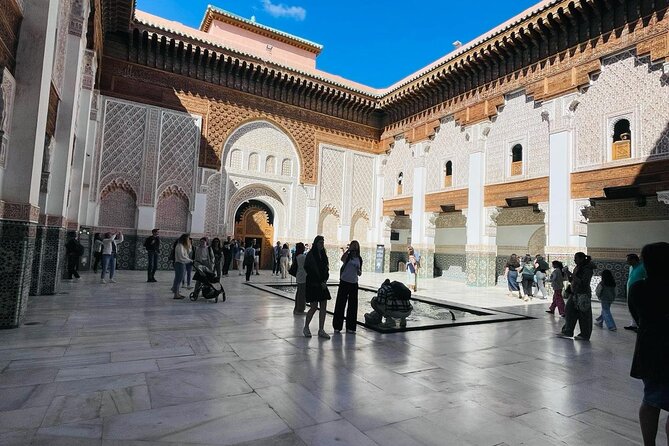
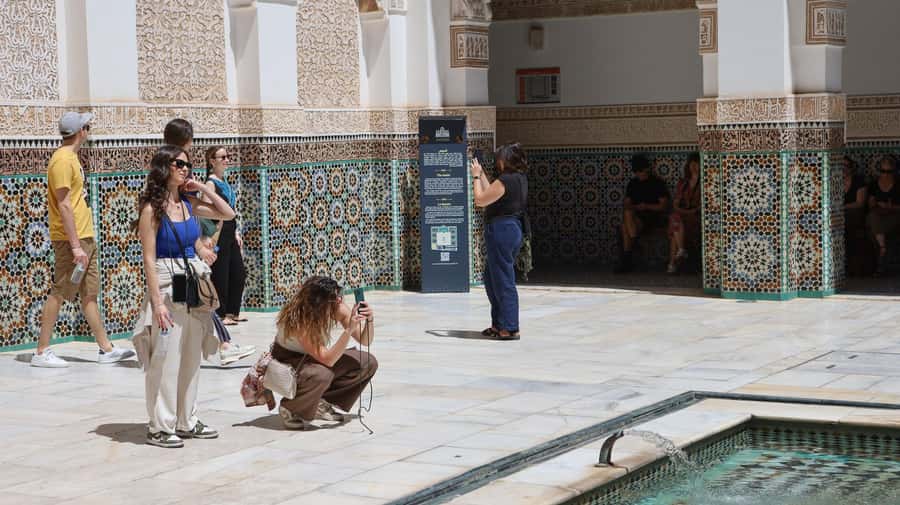
The tour’s “slow down and look closely” moment is Ben Youssef Madrasa. This is an Islamic school founded in the 14th century and rebuilt by the Saadians. It feels different from a palace. It’s more about learning, devotion, and discipline—yet the decoration is stunning.
What to focus on:
- Intricate zellij tilework around the main spaces
- Stucco plaster patterns that look crisp and layered up close
- Carved cedar detail in the architectural elements
- A calm central courtyard that creates a natural pause in the middle of the tour’s movement
You’ll spend around 45 minutes here, with guided instruction plus time to explore on your own.
If you love architecture, this is often the stop that sticks. It’s one thing to see carved ceilings in photos; it’s another to walk the geometry and feel how designed the light and layout are.
Medina walking: UNESCO streets that still function
After the madrasa, you move into Marrakesh Medina, listed by UNESCO. This part of the tour is about navigating the real city: narrow alleys, active street life, and shops that look like they’ve been there for generations.
The guided walk time is about 40 minutes, which is just long enough to:
- get your bearings
- understand how the souks connect
- spot small things you’d likely miss if you were rushing
Keep your eyes open for handwoven textiles and everyday details. The Medina doesn’t feel staged because people are still doing their normal routines there.
One practical reality: you’ll want to stay alert with your footing and your belongings. Medina walking is part of the experience—just treat it like you would any crowded old city street: aware, not alarmed.
Jemaa el-Fna at the end: using the square as your “reset”
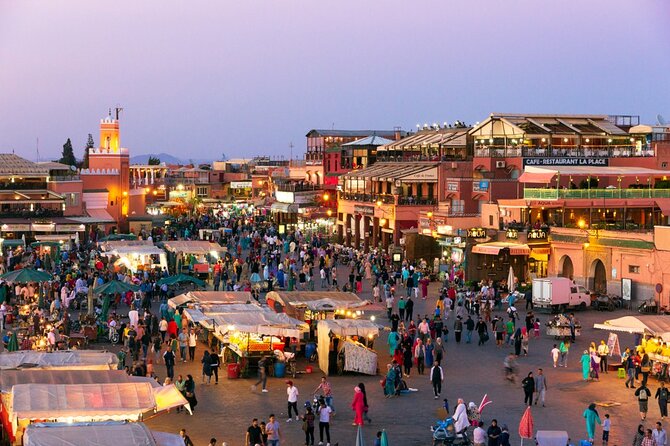
The tour finishes with Jemaa el-Fna, adding about 15 minutes of guided sightseeing before drop-off. You’ll have two possible end points: back in the Medina area or at Café de France in Jemaa el-Fna.
This ending works well because Jemaa el-Fna is where you can naturally re-plan your evening. You’ll know where you are, and you’re not trying to escape the first maze you entered earlier that day.
Price and value: $19 plus tickets, but you’re paying for time saved
On paper, the tour price is listed at $19 per person for about 4 hours with a licensed guide. The key detail: monument entry tickets are not included. You pay:
- Bahia Palace: 100 MAD per adult
- Ben Youssef Madrasa: 50 MAD per adult
That means you should plan on bringing enough cash for both monuments. When the ticket costs are extra, I measure value differently. I ask: are you getting enough guide-led time inside the places that matter?
In this case, yes. Bahia Palace and Ben Youssef Madrasa are the two stops where a guide adds the most. You get explained details, skip-the-line support for initial ticket logistics, and time to explore afterward. For many first-time visitors, that’s the difference between seeing pretty rooms and actually understanding what makes the decorations and courtyard design special.
What the guide style can feel like (and why it affects your day)
A lot of the best feedback centers on guide performance. Names that show up often include Yassine, Mouhssine, Mustapha, Ayoub, Achraf, Hassan, Ismail, Ahmad, and Lachen. While you can’t guarantee a specific guide, the pattern matters: the guides are typically described as friendly, attentive to pace, and good at answering questions.
You’ll also see practical touches in the guidance:
- helping you move through crowds safely
- timing stops so you’re not rushing through the parts you paid to see
- making sure the group is okay at each transition
Some guides are also noted for good photo help, which is handy if you’re traveling in a couple or family and want fewer missed shots.
Ramadan timing: build your schedule around earlier closing hours
During Ramadan (dates given as February 18 to March 20 in the tour info), monuments close earlier. Morning tours start at 09:30 instead of 10:00, and afternoon tours start at 13:00 instead of 14:00. If your trip overlaps Ramadan, pick a start time that gives you breathing room, and remember you’ll likely have tighter light-and-crowd conditions.
Also note: Koutoubia Mosque remains an outside-only viewing experience, and interior access can be restricted during prayer times.
Who this tour suits best (and who should think twice)
This fits well if:
- you want a first-day or second-day overview of Marrakech highlights
- you care about architecture and design details
- you’d rather have a guide handle the crowd navigation and ticket-line friction
- you like souks but want them guided enough to feel purposeful
Think twice if:
- you don’t handle walking well. The route includes Medina walking segments and short transfers between areas.
- you need fully accessible routes. The info lists wheelchair accessibility, but it also states the tour is not suitable for people with mobility impairments. If accessibility is a key issue, I’d contact the provider before booking and ask how they handle the Medina paths for your specific situation.
Should you book this Marrakech tour?
I’d book this tour if you want a guided “greatest hits” loop that still respects details—especially Bahia Palace and Ben Youssef Madrasa. The pricing works as long as you budget for the separate tickets and show up with comfortable shoes and patience for Medina walking.
Skip it (or choose a different format) if you’re only looking for a quick photo run with no interest in the why behind the art, or if walking inside the Medina is a deal-breaker for you.
If you’re trying to get oriented fast and you like the idea of a guided mix of palace craft, madrasa architecture, and Medina streets, this is one of the most practical ways to do it in a half-day.